
How Cloud Free Turned a Stronger Ecommerce Foundation Into Record Sales Growth
A stronger e-commerce platform, better measurement, more effective paid acquisition, and an integrated digital marketing strategy helped Cloud Free achieve a record sales month—including 44% month-over-month net sales growth and 43% growth in orders.
For Cloud Free, growth wasn’t simply a matter of sending more visitors to its website.
It required bringing the technical and marketing sides of ecommerce together: creating a faster, more reliable shopping experience, understanding where customers were coming from, investing confidently in paid acquisition, strengthening organic visibility, and building new ways to engage existing customers.
Working with Mode Effect gave Cloud Free a partner across each of those areas.
The result has been a more mature ecommerce operation—and a business positioned to take its next steps toward scale.
Key Results
- 44% month-over-month net sales growth during a record June
- 43% month-over-month order growth
- 7.36% organic conversion rate during the record month
- 29% email open rate
- 4% average email click rate
- Google Shopping and paid advertising became meaningful revenue drivers
- Improved analytics provided greater visibility into marketing attribution and performance
- Increased transactions and conversion despite a 3.7% decline in overall sessions
- A more stable ecommerce foundation culminating in Cloud Free’s transition to Shopify
From a Purdue Apartment to a Growing Home Automation Business
Cloud Free was founded by Kenny Stier in 2020 around a straightforward idea: smart home technology shouldn’t have to depend on someone else’s cloud.
Many consumer smart home devices rely on a manufacturer’s servers, apps, accounts, and internet connectivity to perform functions that are happening inside the customer’s own home.
Cloud Free took a different approach.
Its products focus on working locally, reducing external dependencies and giving privacy-conscious customers more control over their home automation technology.
Kenny started the business while attending Purdue University, initially selling a batch of smart plugs loaded with firmware that enabled them to operate locally.
An early affiliate relationship with the Self-Hosted podcast helped Cloud Free reach an audience already interested in owning its data and running technology locally.
From those beginnings, Cloud Free continued growing its catalog and customer base, eventually becoming an official Home Assistant distributor.
But as the business grew, its ecommerce infrastructure and marketing needed to grow with it.
The Challenge: Moving Beyond a Founder-Managed Ecommerce Operation
For years, Kenny managed much of Cloud Free’s website himself.
That worked when the company was smaller. As Cloud Free grew, however, maintaining the technical side of the business became increasingly demanding.
The WordPress environment occasionally experienced database and PHP issues. Kenny would troubleshoot configurations himself, but keeping the site stable while simultaneously running the rest of the company was becoming too much to manage.
At the same time, Cloud Free needed more than technical fixes.
The company wanted:
- A more professional and customer-friendly ecommerce experience
- Greater website speed and reliability
- Better visibility in organic search
- More effective paid acquisition
- Reliable ecommerce analytics and attribution
- Consistent email marketing
- A partner who understood how all of those components contributed to revenue
Kenny wasn’t looking for someone to simply tackle isolated development tickets.
“I could hire a dev agency or Fiverr or a freelancer and fix little things here and there… But it’s really been helpful to have Mode Effect by our side.”
Cloud Free needed a partner that understood ecommerce as a complete system.
The Strategy: Connect Technology and Marketing Around Revenue
From the beginning of the partnership, Mode Effect’s role extended beyond website development.
The objective was to create a stronger ecommerce foundation while simultaneously improving how Cloud Free acquired, measured, converted, and retained customers.
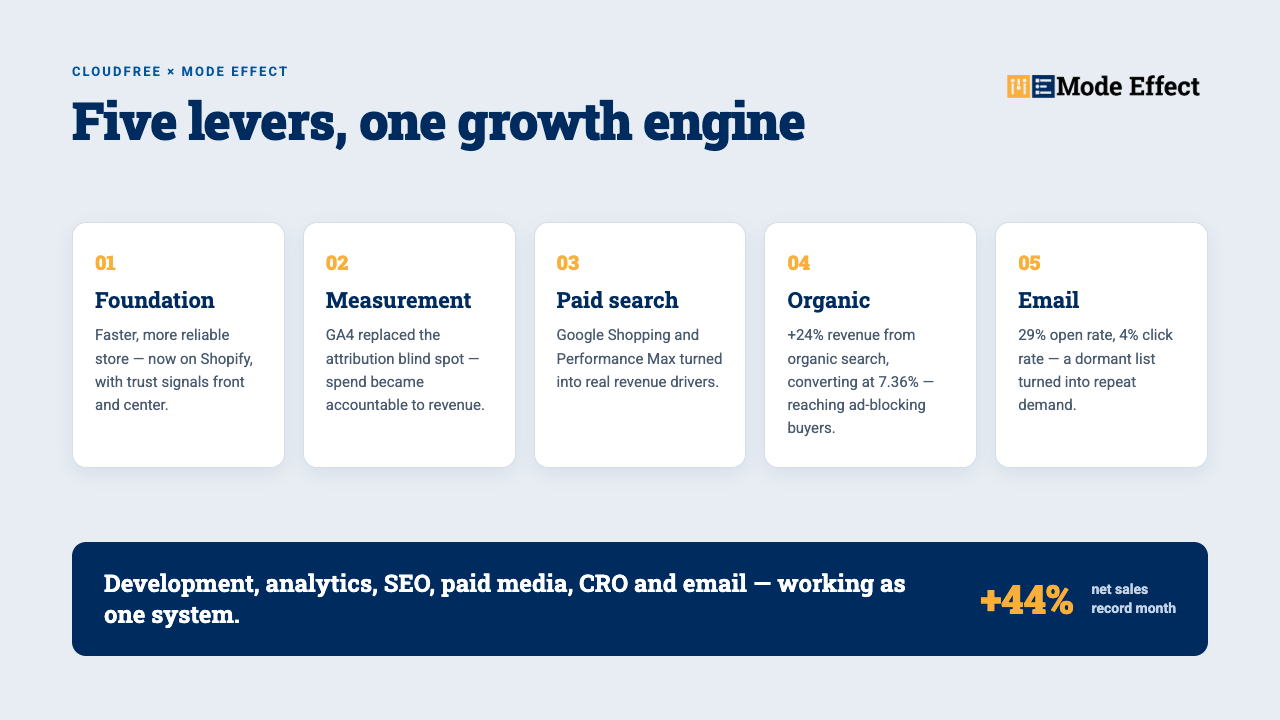
That meant treating development, analytics, paid media, SEO, conversion optimization, and email as interconnected parts of the same growth strategy.
As Kenny described it:
“Right from the start… it was definitely very clear that you guys were really experienced in the e-commerce space, had a marketing team who knew how to run ads and emails, and really it was a whole package.”
The work centered around several critical growth levers.
1. Build a Faster, More Reliable Ecommerce Experience
Driving qualified traffic only creates value when the website can convert it.
Cloud Free’s original website had reached a point where reliability, speed, design, and usability needed greater attention.
Mode Effect worked with Cloud Free to improve the customer-facing experience and strengthen the technical foundation behind it.
That included focusing on factors such as:
- Site performance
- Product content
- Customer-friendly design
- Checkout usability
- Shipping information
- Support information
- Return policies
- Trust signals throughout the purchase journey
Those improvements became particularly important once Cloud Free began investing more heavily in customer acquisition.
As Kenny put it:
“If you’re gonna pay to bring people to your site, you better make sure that everything on the site is running smoothly… if a customer sees an ad, hits your site, and gets caught up in the checkout process or has an unanswered question, that’s money going to waste.”
Eventually, the partnership also led to a larger technical decision: moving Cloud Free to Shopify.
For Kenny, that transition represented an opportunity to put the business on a platform where site stability and checkout reliability could become less of a day-to-day concern.
2. Replace Analytics Blind Spots With Better Ecommerce Measurement
Cloud Free previously used Matomo, a self-hosted open-source analytics platform.
While it provided useful information such as page views and order data, it left an important gap as Cloud Free began investing in advertising: accurately understanding how marketing activity translated into ecommerce revenue.
Mode Effect helped implement GA4 and improve ecommerce measurement.
The difference wasn’t simply having another analytics dashboard. It gave Cloud Free better visibility into attribution—particularly the ability to understand where traffic and sales were coming from.
“Without knowing where your traffic is coming from, you really don’t know much at all. That’s huge in e-commerce. And with that blind spot, you’re walking around blind trying to run a business.”
Better measurement also gave Cloud Free more confidence when making decisions about advertising and future growth.
Instead of looking at traffic in isolation, the company could more clearly evaluate referrals, conversions, orders, revenue, and marketing performance.
That visibility has also helped Kenny think further ahead.
Reliable performance data provides Cloud Free with a better basis for estimating where the company could be in the next three, six, or twelve months.
Turning Google Ads From a Risk Into a Revenue Driver
Before working with Mode Effect, Cloud Free had experimented with Google Ads—but Kenny didn’t consider paid acquisition a serious growth channel.
In fact, the experience had created the opposite reaction.
“Before this, we were afraid to advertise at all.”
Cloud Free would occasionally run ads around a promotion, but without the expertise and measurement necessary to optimize them, Kenny felt like he was essentially burning money.
That changed as Mode Effect connected better analytics with professional campaign management.
Google Shopping became particularly important.
By putting Cloud Free products directly in front of shoppers searching for them, the company could capture high-intent demand that previously may have gone elsewhere.
Performance Max also expanded the company’s ability to place products across Google’s advertising ecosystem while focusing spend on opportunities capable of generating sales.
Most importantly, Cloud Free could now see whether those advertising dollars were producing results.
“Even though we’re paying for it… the ads, they are paying for themselves. We’re not losing money, blowing—burning money—on Google Ads. And we can see that with the GA4 data.”
That changed paid media from something Cloud Free was hesitant to invest in into an important component of its growth strategy.
Kenny described the sales growth since adopting Google Ads with Mode Effect as “really incredible.”
Organic Search Remained a Critical Part of the Equation
Paid media wasn’t the only acquisition channel receiving attention.
Mode Effect also worked with Cloud Free on SEO, including product descriptions, site performance, and search visibility.
For Cloud Free, organic search is particularly important because of its audience.
Many Cloud Free customers are technically sophisticated and privacy-conscious. They may use browser extensions, DNS-level ad blockers, or other tools that prevent them from seeing paid advertising altogether.
That makes strong organic positioning essential.
“A lot of our clients may not even see the ads that we run… So being able to get good placement in the organic search side is very important to our customer base.”
During Cloud Free’s record June, organic search generated 24% period-over-period revenue growth and converted at approximately 7.36%.
The combination of paid and organic acquisition created a stronger overall search strategy: paid media could capture immediate demand while organic visibility helped Cloud Free reach customers who may never see an advertisement.
The Result: More Revenue Without More Traffic
One of the clearest signs of the partnership’s impact appeared during Cloud Free’s record June.
Net sales increased 44% month over month.
Orders increased 43% month over month.
And that happened while overall sessions actually declined 3.7%.
In other words, the record wasn’t driven simply by pouring substantially more traffic into the top of the funnel.
Cloud Free generated more transactions from a slightly smaller pool of sessions.
For Kenny, the improvement came back to the quality of the ecommerce experience:
“I would have to point again to a professional-looking site that performs well. Trust indicators about our shipping policy, our support policy, our return policy, having those front and center for the customer definitely helps make up minds when it comes to the checkout process.”
It was an example of why acquisition and conversion can’t be treated separately.
Better targeting can bring more relevant visitors to the site. Better SEO can capture people actively searching for the right products. But the ecommerce experience still needs to turn that intent into a completed purchase.
Cloud Free’s record month demonstrated the power of improving both sides.
It is also important to put the result in context. Competitor inventory shortages contributed to Cloud Free’s June performance. As an official Home Assistant distributor with available inventory, Cloud Free was positioned to capture demand when customers couldn’t purchase products elsewhere.
But having inventory alone wasn’t enough.
Cloud Free also needed to be discoverable when that demand appeared—and provide a trustworthy, frictionless experience capable of converting those shoppers once they arrived.
June was especially notable because summer is not ordinarily Cloud Free’s peak season. Kenny said November, December, and January are typically the company’s busiest months.
Building Customer Relationships Beyond the First Purchase
As Cloud Free’s acquisition strategy matured, Mode Effect also helped the company develop another underutilized channel: email.
The demand was already there.
Kenny recalled customers reaching out because they had subscribed to Cloud Free’s email list but weren’t receiving emails.
The challenge was capacity.
Creating professional campaigns, planning content, promoting new products, and consistently communicating with subscribers represented another marketing responsibility Kenny didn’t have time to own personally.
Mode Effect helped Cloud Free begin putting that audience to work.
Early results included approximately a:
- 29% email open rate
- 4% average click rate
For Kenny, the engagement confirmed that Cloud Free had an audience genuinely interested in the company, its products, and developments throughout the Home Assistant ecosystem.
Email now gives the company a channel for announcing new products, promoting sales, highlighting existing inventory, gathering customer feedback, and encouraging repeat purchases.
It also supports Cloud Free’s larger goal of expanding customer interest beyond a handful of historically successful products.
Instead of being known only for flagship smart plugs or Home Assistant products, Cloud Free can introduce customers to light switches, motion sensors, door sensors, and other locally controlled home automation products.
The long-term objective is to become a trusted destination where customers know the products have been curated around a common principle: they work locally and work well with Home Assistant.
Before and After
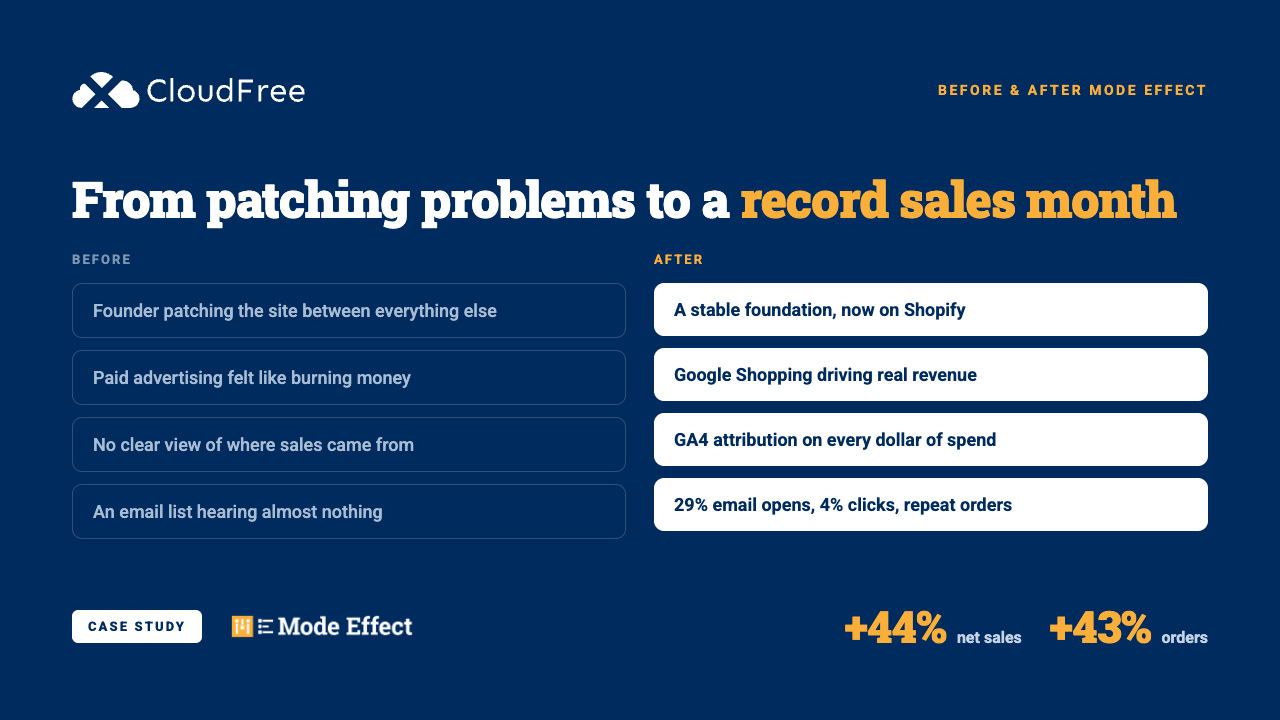
| Before Working With Mode Effect | After Working With Mode Effect |
|---|---|
| Founder managing many website issues himself | Dedicated ecommerce technical partner |
| Periodic stability and performance concerns | Stronger technical foundation and transition to Shopify |
| Limited confidence in paid advertising | Google Ads and Shopping became meaningful revenue drivers |
| Difficulty connecting advertising to sales | GA4 provides stronger attribution and ecommerce measurement |
| Paid advertising felt like “burning money” | Advertising performance can be measured against sales |
| SEO managed alongside numerous other founder responsibilities | Ongoing focus on organic visibility and optimization |
| Email subscribers received little consistent communication | Active email strategy generating measurable engagement |
| Technical and marketing efforts handled separately or ad hoc | Development, analytics, SEO, paid media, CRO, and email work together |
| Growth risked reaching a plateau | Record sales growth and preparation for the next stage of scale |
A Partnership Built Around the Entire E-commerce Business
One of the biggest changes for Cloud Free hasn’t been a single campaign, platform, or technical improvement.
It’s been the ability to connect them.
Cloud Free and Mode Effect meet every other week to review performance and discuss SEO, AEO, paid media, email, development needs, and upcoming priorities. A shared Slack channel gives Cloud Free direct access to the team between meetings.
That structure means the people responsible for development understand what’s happening in marketing—and the marketing team understands what’s changing across the business.
Instead of Kenny having to coordinate multiple specialized vendors, the work remains connected.
“It keeps things more cohesive… Even though I might be talking to the marketing team, the dev side is gonna hear that or the email side, to make all those pieces work together.”
When asked whether he considered Mode Effect a vendor, an agency, or an extension of Cloud Free’s team, Kenny’s answer was straightforward:
“Ultimately they’re part of the team, right? They are our ads person. They are our SEO manager. At the end of the day, they’re crucial to our success.”
Creating the Foundation for Cloud Free’s Next Stage
The impact of Cloud Free’s growth is beginning to extend beyond marketing metrics.
A record sales month means more orders to pick, pack, and ship. That has pushed the company to look at more efficient fulfillment processes and ways to make better use of its existing team.
More significantly, Kenny expects Cloud Free may need to expand into a larger warehouse within the next six to twelve months.
Those are operational decisions made possible by a business moving into a different stage of growth.
And when asked where Cloud Free might be without the changes made through the partnership, Kenny described a very different trajectory:
“We wouldn’t have Google Shopping set up. We wouldn’t have ads or emails. We would be on a plateau, I guess, from where we were before. I don’t think we’d be seeing near the growth that we have seen.”
That captures the broader outcome of the Cloud Free and Mode Effect partnership.
This wasn’t simply a website redesign, an advertising engagement, an analytics implementation, or an SEO project.
It was about putting the individual components of ecommerce growth together.
A better technical foundation made marketing investment more valuable. Better analytics made that investment measurable. Paid and organic search brought qualified customers into the business. Conversion improvements helped turn that demand into revenue. Email created a way to continue the relationship after the initial visit or purchase.
Together, those improvements gave Cloud Free a stronger ecommerce engine—and the confidence to think about what’s next.
The Strategic Takeaway
Ecommerce growth doesn’t come from traffic alone.
A company can spend more on advertising, rank for more keywords, or generate more sessions, but those investments become significantly more valuable when the underlying ecommerce experience is fast, reliable, measurable, and designed to convert.
Cloud Free’s record month illustrates that point particularly well: sales increased 44% and orders increased 43% even as sessions declined 3.7%.
For a growing ecommerce company, technical performance and digital marketing shouldn’t operate as separate disciplines.
They should reinforce one another.
As Kenny put it:
“If you have an e-commerce site, you need the e-commerce professionals. And you can get that with Mode Effect.”
Looking to turn your ecommerce website and digital marketing into a more cohesive growth engine? Mode Effect brings development, analytics, paid media, SEO, conversion strategy, and email together around the metrics that matter to your business.
:::
