
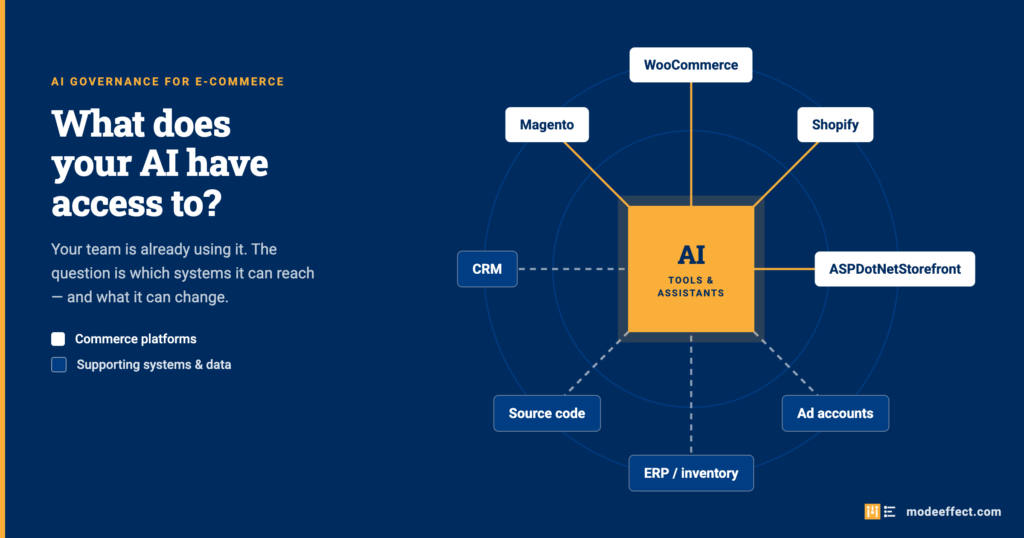
Your Team Is Already Using AI. Do You Know What It Has Access To?
For a lot of small and mid-sized e-commerce businesses, AI adoption isn’t happening through a formal company-wide initiative.
It’s happening one person at a time. That’s why AI governance for e-commerce businesses is becoming an urgent conversation — even for companies with a dozen employees.
A salesperson starts using ChatGPT to analyze customer information. A marketing consultant uses AI to summarize campaign performance. A developer uses an AI coding assistant to speed up a new feature. Someone on the operations team exports order data into an AI tool to find patterns. A contractor creates a custom workflow that connects an AI model to one of your internal systems.
None of these things necessarily sounds alarming on its own. In fact, many of them are exactly the kinds of experiments businesses should be running.
The problem is that they can add up quickly.
For the kinds of e-commerce companies we often work with, this deserves more attention than it’s currently getting. A company might only have 10 employees but do $5 million, $10 million, or $20 million in annual revenue. It may operate one or several online stores. It may depend on outside developers, marketing agencies, sales representatives, fractional executives, software vendors, shipping partners, accountants, consultants, and other specialists.
That creates a strange reality: the business may have a relatively small internal team, but there can be a lot of people touching its systems, data, customers, and workflows.
Now AI is being layered on top of all of that.
The important question is no longer just:
Are we using AI?
It’s becoming:
Who is using AI, what does it have access to, and what can it do with that access?
We don’t pretend to have every answer to that question. Nobody does. AI tools, models, integrations, and capabilities are changing too quickly for any business to believe it can write one policy today and consider the subject finished.
But we do think e-commerce businesses need to start having this conversation now.
Small Companies Can Have Very Complicated Technology Environments
There’s a tendency to associate technology governance with large enterprises. That can make the subject feel irrelevant to a 10-person company.
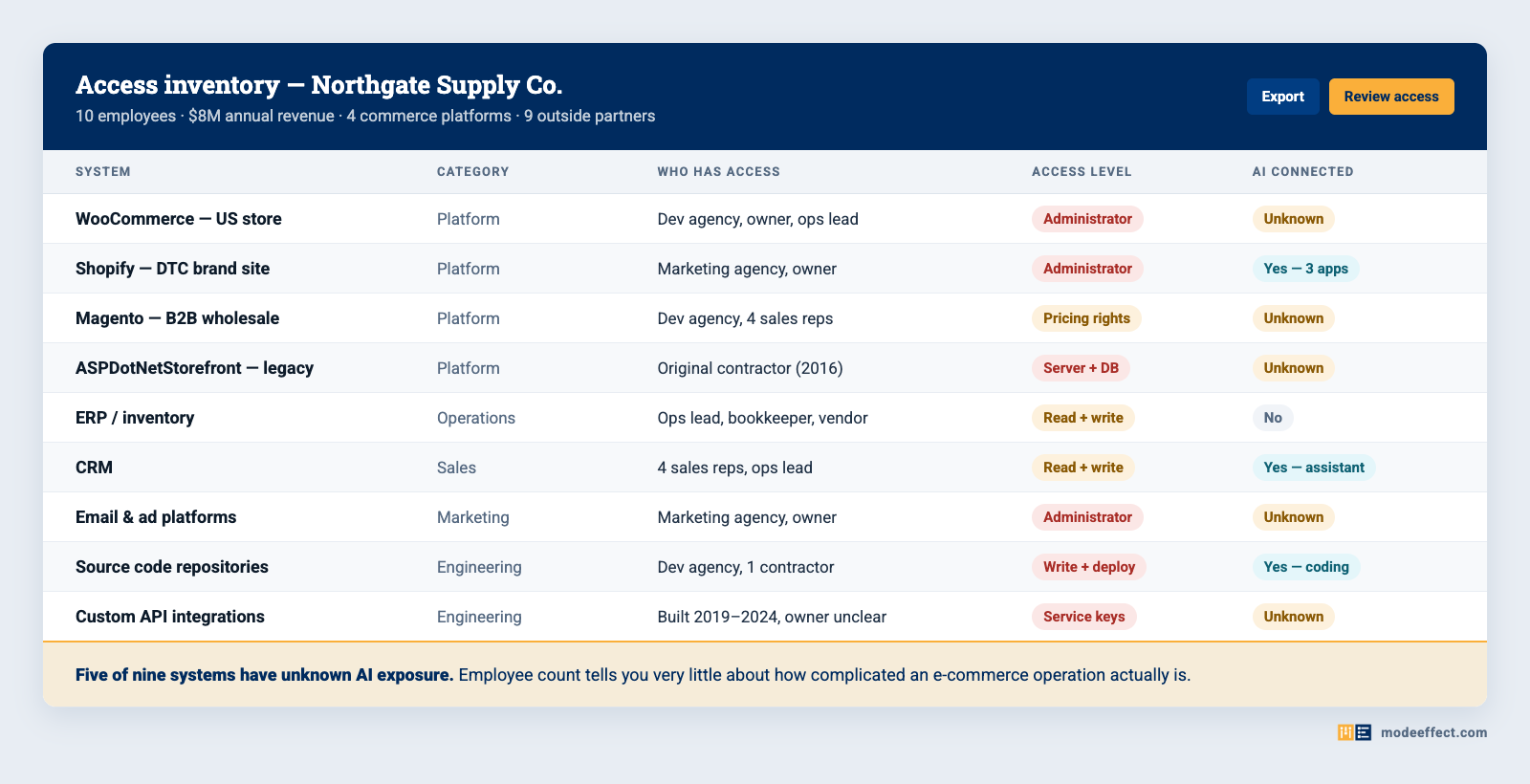
But employee count doesn’t tell you very much about how complicated an e-commerce operation actually is.
Consider a hypothetical business with 10 employees and $8 million in annual revenue. Its technology environment might include:
- Shopify, Magento, WooCommerce, or a custom ASP.NET storefront
- An ERP or inventory-management platform
- A CRM
- Klaviyo or another email marketing platform
- Google Analytics
- Google Ads and Meta Ads
- Shipping software
- Payment gateways
- Tax software
- Customer-service tools
- A product information database
- Shared cloud documents
- Custom APIs
- Third-party plugins or apps
- Custom integrations built over several years
Then consider the people who might interact with those systems. The company could have an outside development team maintaining the website, a separate marketing agency managing paid media, independent sales representatives, a consultant helping with operations, a bookkeeping service, fulfillment partners, software vendors, and employees working across sales, marketing, customer service, and administration.
That’s a lot of hands. And those hands often have different levels of access.
One person may have Shopify administrator credentials. Another may have access to the CRM. A developer may have server credentials. A marketing partner may have access to analytics and advertising platforms. A salesperson may be able to view customer accounts, quotes, purchase history, or pricing.
Over time, access accumulates because someone needs something in order to get a job done. That’s normal.
AI changes what that access can mean.
AI Can Make Existing Access Much More Powerful
One of the most important changes AI introduces is that it lowers the technical barrier to doing things that previously required specialized knowledge.
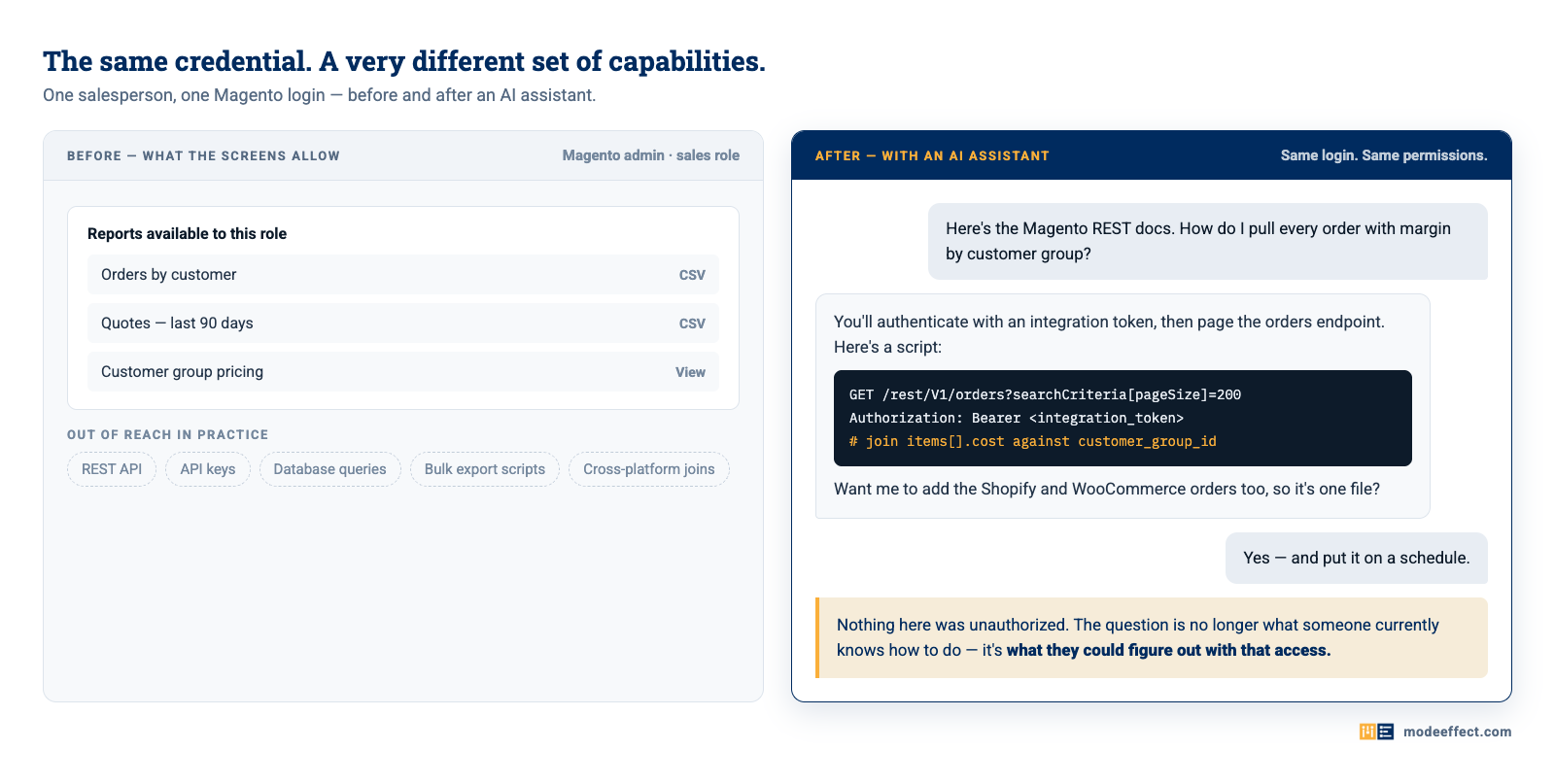
Consider a salesperson who has access to a business application. Historically, that person might know how to use the screens and reports available to them but have little idea what’s happening behind the software. They might not know how an API works, how to read technical documentation, what an API key is, how databases are structured, or how two systems exchange information.
With AI assistance, that gap can shrink dramatically.
Someone can paste documentation into an AI tool and ask what it means. They can ask an AI model to explain an API. They can ask for help writing a script. They can troubleshoot authentication. They can ask questions about fields, endpoints, exports, integrations, or database queries.
That’s incredibly powerful. It’s one of the reasons we’re excited about AI. People can solve problems that previously would have required more time, more technical knowledge, or more outside help.
But the same capability means businesses need to rethink some assumptions about access.
If someone has access to a system, the important question may no longer be only what that person currently knows how to do. The question is increasingly:
What could someone figure out how to do with that access when an AI assistant is helping them?
That’s a different way of thinking about permissions.
This Is Not About Distrusting Your Employees or Partners
It would be easy to turn this into a security scare story. That’s not the point.
Most people experimenting with AI inside a company aren’t trying to expose confidential information or bypass security controls. They’re trying to get their jobs done.
A salesperson may want better reporting. A marketing consultant may want to identify purchasing trends. A customer-service employee may want faster answers. A developer may want to solve a technical problem more efficiently. A business owner may ask someone, “Can AI help us automate this?”
Those are reasonable questions.
The risk is often not malicious behavior. It’s capability expanding faster than the organization understands the consequences.
Someone discovers that an existing credential gives them access to more information than expected. An employee uploads a spreadsheet into an AI platform without realizing what customer data is included. A consultant connects an AI service to an account using credentials that are broader than necessary. A developer builds an automation that starts as an experiment and quietly becomes part of daily operations.
None of these scenarios requires bad intent. They require only a combination of useful technology, broad access, and unclear boundaries.
That’s why AI governance shouldn’t begin with suspicion. It should begin with visibility.
Start by Asking Who Is Already Using AI
A lot of companies want to begin their AI strategy by selecting tools. We think there’s an earlier step:
Find out what’s already happening.
You may discover more AI usage than you expect. Ask your employees and partners questions such as:
- Which AI tools are you currently using for work?
- What tasks are you using them for?
- Are you entering customer information into them?
- Are you uploading spreadsheets, reports, or documents?
- Have you connected any AI tools directly to company systems?
- Are you using AI to analyze sales or marketing information?
- Are developers using AI assistants with access to company code?
- Are outside agencies using AI when working with your data?
- Are sales representatives using AI with customer or pricing information?
- Are any AI-generated actions happening automatically?
The objective isn’t to catch people doing something wrong. The objective is to understand the environment that already exists.
For a small company, that conversation may be more valuable than writing a 50-page AI policy.
Know What Data Is Leaving the Business
The next question is straightforward:
What information are people giving to AI systems?
For an e-commerce business, that information could include far more than website copy. It could include:
- Product information
- Pricing
- Customer names
- Customer contact information
- Order history
- Sales performance
- Internal margins
- Vendor pricing
- Marketing reports
- Sales notes
- Support conversations
- Internal documentation
- Employee information
- Source code
- API documentation
- Business plans
Some of this information may be perfectly appropriate to use with an approved AI platform. Some may require additional controls. Some may not need to be shared at all.
The important point is that the business should make that decision intentionally. It shouldn’t happen accidentally because someone copied a spreadsheet into a prompt.
Pay Attention to Your Outside Partners
This is especially important for smaller e-commerce companies because so much expertise is outsourced.
An enterprise may have internal teams responsible for development, marketing, cybersecurity, analytics, infrastructure, and compliance. A smaller business often assembles those capabilities from outside partners.
That means AI governance can’t apply only to employees.
Your development agency may use AI. Your marketing agency almost certainly uses AI somewhere in its process. Your freelance copywriter may use it. Your sales consultants may use it. Your technology vendors may have AI features embedded directly into their software.
None of that is automatically a problem. But it does mean business owners should start asking their partners better questions. For example:
How are you using AI when working on our account?
What client data might be processed by those tools?
Are AI tools connected directly to any of our systems?
Who has access to those connections?
Are there actions the AI can perform automatically?
How are outputs reviewed before they affect customers or the website?
Those should become normal vendor-management questions.
Give AI Enough Access to Do the Job, Not Everything
The security industry has used the concept of “least privilege” for a long time. The terminology sounds technical. The idea isn’t: give people and systems the minimum access they need to accomplish the task.
AI should be treated the same way.
Imagine you want to build an AI tool that analyzes which products are selling best. It probably needs access to product and order information.
Does it need the ability to refund orders? Probably not. Does it need administrative access to your website? Probably not. Does it need to modify product prices? Probably not.
Or consider a customer-service assistant. It may need to look up order status. That doesn’t necessarily mean it should have access to every customer field in the CRM.
A marketing consultant may need product information and analytics. That doesn’t automatically mean the consultant’s AI tools need access to accounting data or administrative credentials.
The principle is simple:
Access should match the job.
AI makes that principle more important because an intelligent system can often do more with a piece of information than the person who originally received access to it.
There Is a Big Difference Between Reading and Acting
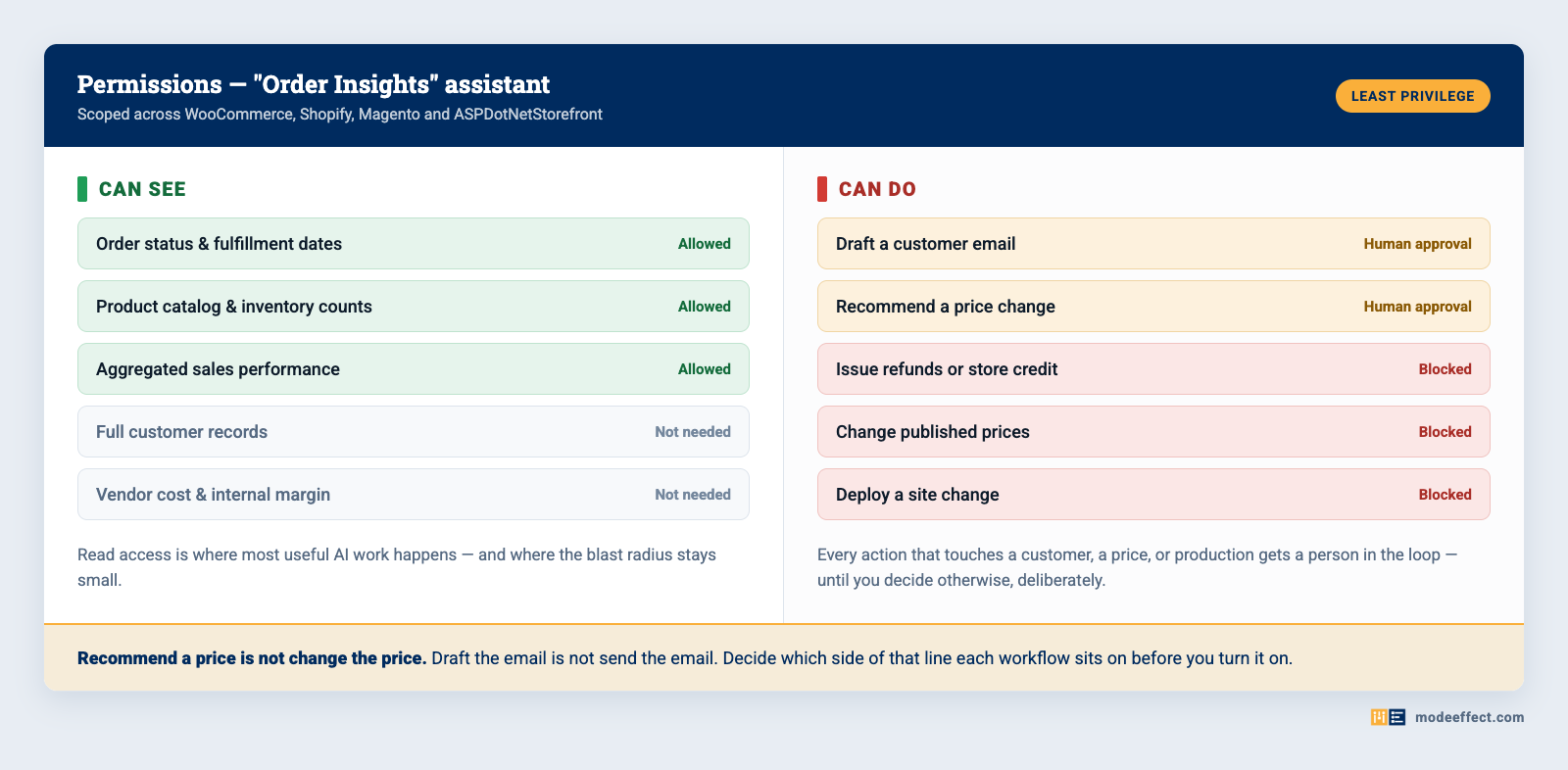
Another distinction businesses need to start making is the difference between AI that can see something and AI that can do something.
Imagine an AI system that reviews your orders and says:
These five orders appear to be delayed.
That’s one level of access.
Now imagine the AI system can automatically cancel those orders, issue refunds, send customer emails, and update inventory. That’s a completely different level of responsibility.
The same distinction applies across an e-commerce operation. There’s a big difference between:
Recommend a new price and change the price.
Draft an email and send the email.
Identify a customer-service issue and issue store credit.
Suggest a website change and deploy the change.
Analyze a marketing campaign and change the budget.
The more AI moves from recommendation into action, the more businesses need to define where human approval belongs.
We don’t believe every AI-assisted action needs manual approval forever. That would defeat a lot of the value of automation. But businesses should deliberately decide which actions can happen automatically and which ones still require a person.
AI Output Still Needs Human Judgment
The same principle applies to output.
We’re already seeing a lot of generic AI-generated content. It’s easy to generate. That doesn’t make it good.
AI can produce a product description in seconds. But does it understand why customers buy the product? Does it know which claims are accurate, how your products differ from competitors, or the terminology your customers actually use?
The same challenge exists in development and reporting. AI can generate code, but that doesn’t mean the code is secure, maintainable, or appropriate for the business. AI can summarize data, but that doesn’t guarantee it drew the correct conclusion.
The businesses that benefit most from AI won’t necessarily be the ones generating the most AI output. They’ll be the ones developing the best process around it — good source data, business context, clear objectives, quality standards, and knowledgeable people reviewing the results.
AI Governance Should Help People Experiment
The word “governance” can make people imagine committees, policies, bureaucracy, and people saying no.
That’s not what we think small e-commerce companies need. AI governance should make experimentation easier.
A business owner should be able to tell an employee:
“Yes, experiment with AI. Here are the tools we’ve approved. Here is the information you can use. Here is the information you should not upload. If you want to connect AI directly to one of our systems, talk to us first.”
That creates freedom inside reasonable boundaries.
Without boundaries, companies often end up in one of two situations. Either everyone experiments independently and nobody knows what’s connected to what, or leadership becomes nervous and tries to prohibit AI entirely. Neither approach is especially productive.
A better approach is controlled experimentation. Try things. Measure whether they create value. Give AI access where access is justified. Add oversight as the stakes increase. Remove tools and workflows that aren’t useful. Document the ones that become important.
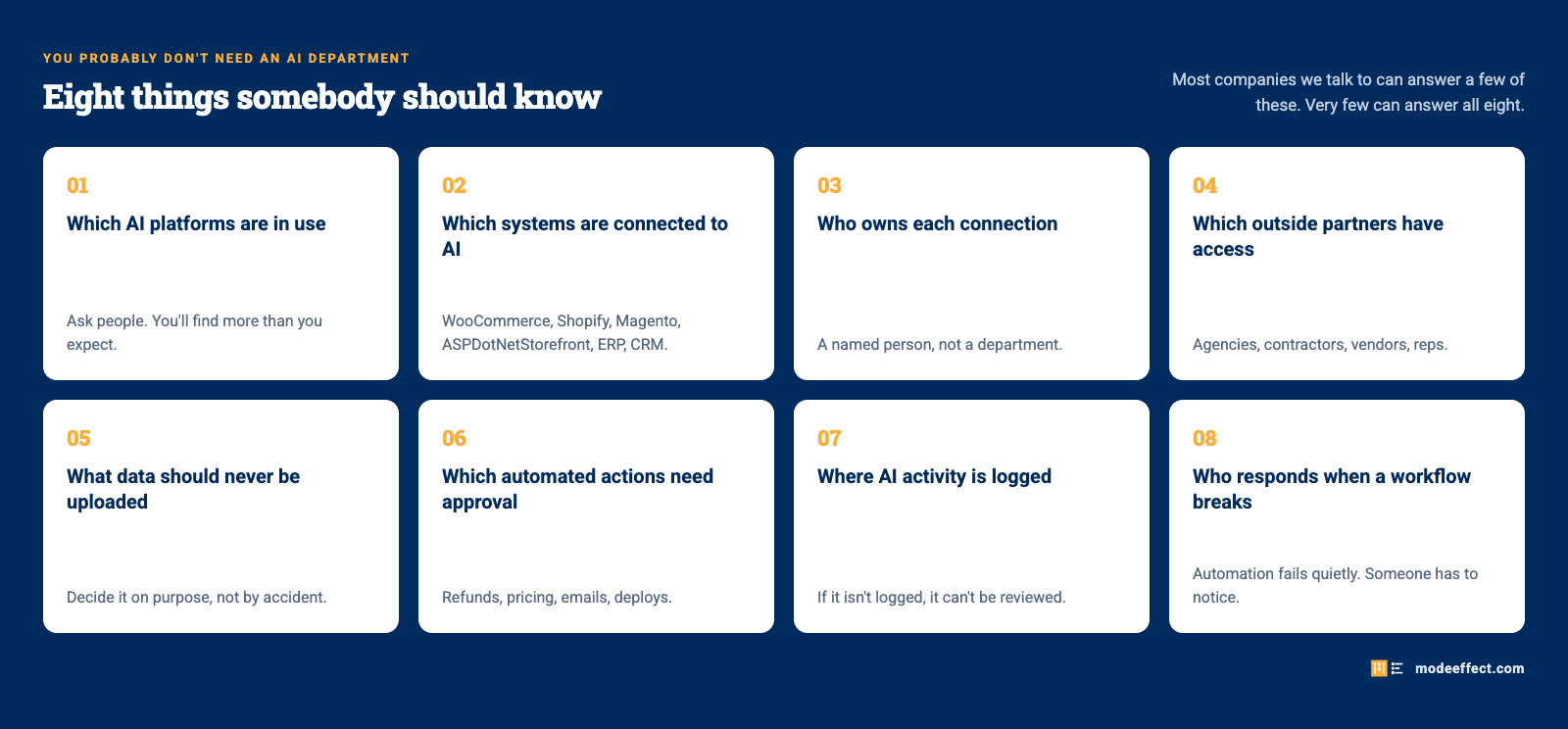
You Probably Don’t Need an “AI Department”
For a company with 10 employees, creating a formal AI governance team probably makes no sense. But somebody does need to understand the overall environment.
At a minimum, businesses should know:
- Which AI platforms are commonly being used
- Which company systems are connected to AI
- Who owns those connections
- Which outside partners have access
- What sensitive data should not be shared
- Which automated actions require approval
- Where important AI activity is logged
- Who is responsible when an AI workflow stops working
That’s manageable. It’s also something businesses can improve over time.
Your Technology Partner Has a Role to Play
This is where the role of an e-commerce development partner is changing.
Our job is still to build, maintain, improve, and support websites. AI doesn’t make reliable e-commerce development less important. But the boundaries of development are expanding. Increasingly, the work may include helping clients determine how AI fits into the rest of their technology.
That can mean:
- Connecting AI to Magento, WooCommerce, Shopify, or an ASP.NET storefront
- Structuring product and customer data
- Reviewing how permissions are configured
- Building custom integrations
- Testing AI-generated code
- Designing approval workflows
- Logging automated activity
- Separating read access from action access
- Helping teams understand where AI should and should not be used
- Working with marketing teams to improve AI-assisted content
- Monitoring whether an AI workflow is actually producing business value
- This is becoming part of modern e-commerce technology strategy. And for small companies with many outside partners, having someone who understands the connections between those systems may become increasingly important.
Your marketing agency understands marketing. Your ERP vendor understands the ERP. Your salesperson understands the sales process. Your development team understands the website. Your business owner understands the company.
AI increasingly sits between all of them. Somebody needs to help connect the dots.
We Are Still Figuring This Out Too
We think it’s important to say this plainly: we don’t have a finished AI playbook. We’re experimenting too.
We’re evaluating tools, workflows, coding processes, marketing applications, integrations, governance questions, security concerns, and ways AI can help our clients. Some ideas will prove extremely useful. Some won’t. Some practices that seem reasonable today will probably change as models and platforms evolve.
That’s exactly why we want to have these conversations openly. The companies we work with don’t need another consultant pretending AI is completely figured out. They need partners willing to ask difficult questions while still helping them move forward.
Where can AI save meaningful time? Where can it improve marketing, development, sales, or customer service? What data does it need? What access should it have? What actions should remain human? What happens when it gets something wrong?
Those are the questions we think are worth working through.
Start Your AI Governance With Visibility
If your company is already using AI, you don’t need to stop everything and build a complicated governance framework.
Start with something simpler: find out what’s already happening.
Talk to your employees. Talk to your developers. Talk to your marketing partners. Talk to your salespeople. Find out which tools they’re using and what information they’re giving those tools.
Look at which systems are connected. Review who still has administrative access. Understand where your API keys and credentials are being used. Then decide where tighter boundaries make sense.
AI can create significant opportunities for smaller e-commerce companies. It can give lean teams capabilities that previously required much larger organizations. It can help employees analyze information, automate repetitive work, improve marketing, write software, serve customers, and make better decisions.
That’s why we’re optimistic about it.
But the same thing that makes AI exciting — its ability to dramatically increase what one person can accomplish — is also the reason businesses need to pay attention to access.
Your team is probably going to use more AI next year than it does today. So will your agencies, your consultants, and your salespeople. The goal shouldn’t be to prevent that. The goal should be to understand it well enough that you can take advantage of the opportunity without accidentally losing visibility into your own business.
That conversation doesn’t have to start with a giant AI strategy. It can start with one simple question:
Who is already using AI, and what does it have access to?
If you’d like help understanding what AI tools are connected to your store — whether it runs on Shopify, WooCommerce, Magento, or an ASP.NET storefront — and what they can access, get in touch. That first conversation is exactly where we’d suggest starting.
