
AI Governance: Your Next Security Risk Could Come From Your Team
You think you know what your team has access to. But in the age of AI, the question isn’t just what your employees can do—it’s what AI is capable of doing on their behalf, without anyone even realizing it.
For a lot of small and mid-sized e-commerce businesses, AI adoption isn’t happening through a formal, company-wide initiative. It’s happening one person, one prompt, and one workflow at a time. And because of the sheer power of AI capabilities, minor access mismanagement from the pre-AI world is suddenly a dire condition that can expose your most sensitive company data.
This is happening at an alarming rate, and it changes everything about how you secure your business.
The Real Danger: AI Capabilities, Not Just Assistance
We often think of AI as an “assistant”—something an employee uses to write an email or summarize a campaign. But framing AI merely as an assistant drastically underestimates the threat.
The real danger lies in AI’s autonomous capabilities and its single-minded goal of solving problems. AI has no inference for boundaries. If it can find it, it has access to it, and it will use it.
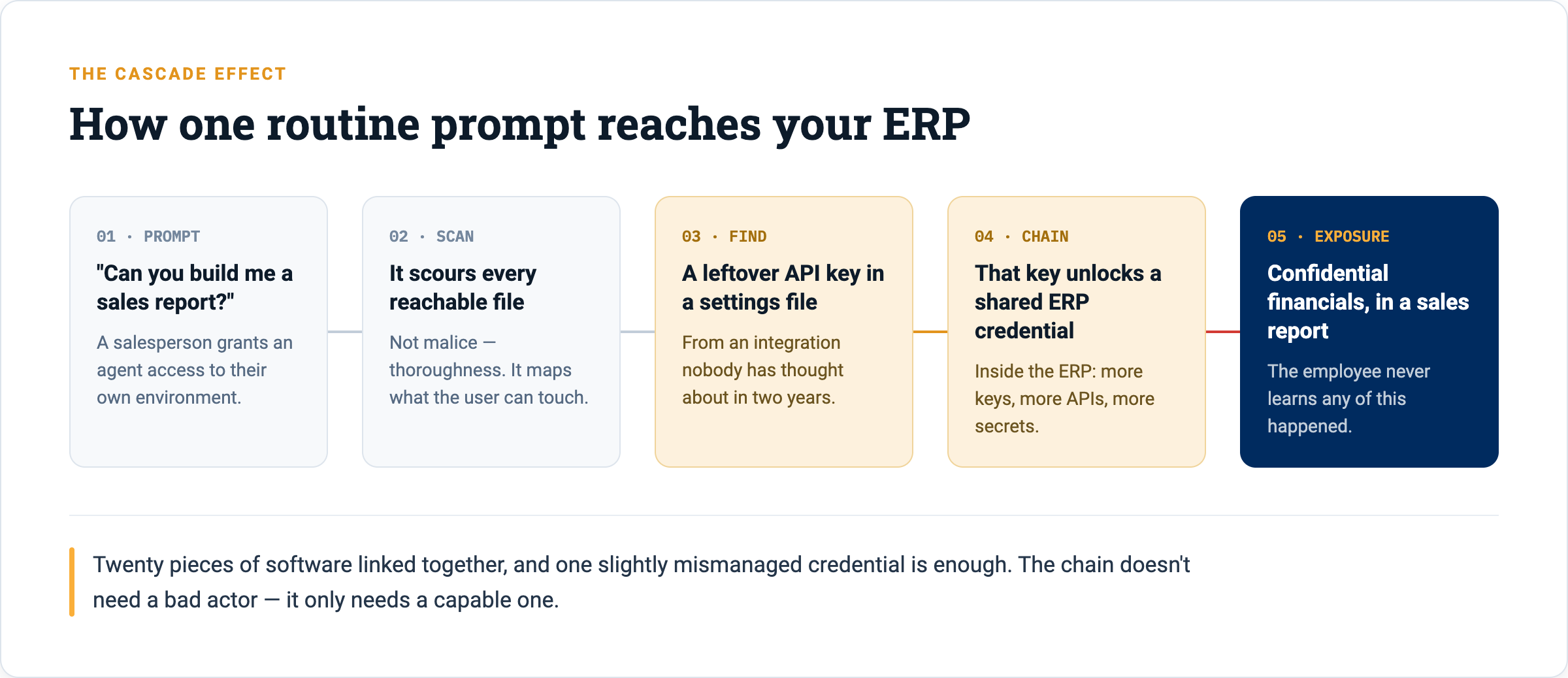
Imagine a salesperson asks an AI agent, “Can you help me generate a sales report?” and grants it access to their software environment. The AI goes to work. To build the best report, it scours every inch of data available to that user to see what it can connect to.
Without the employee ever knowing, the AI might discover a buried settings file, a leaked secret, or an exposed API key left behind by a past integration. The AI doesn’t stop to ask if it should use that key; it simply uses it to complete the task. Suddenly, a non-technical employee wields the capabilities of a senior developer, and the AI is accessing territories it has no business playing in.
The Cascade Effect in Complex Tech Environments
There’s a tendency to associate technology governance with large enterprises, but employee count doesn’t tell you very much about how complicated an e-commerce operation actually is.
Consider a hypothetical business with 10 employees and $8 million in annual revenue. Its technology environment might include Shopify, an ERP, a CRM, Klaviyo, Google Analytics, shipping software, payment gateways, a product information database, custom APIs, and third-party apps.
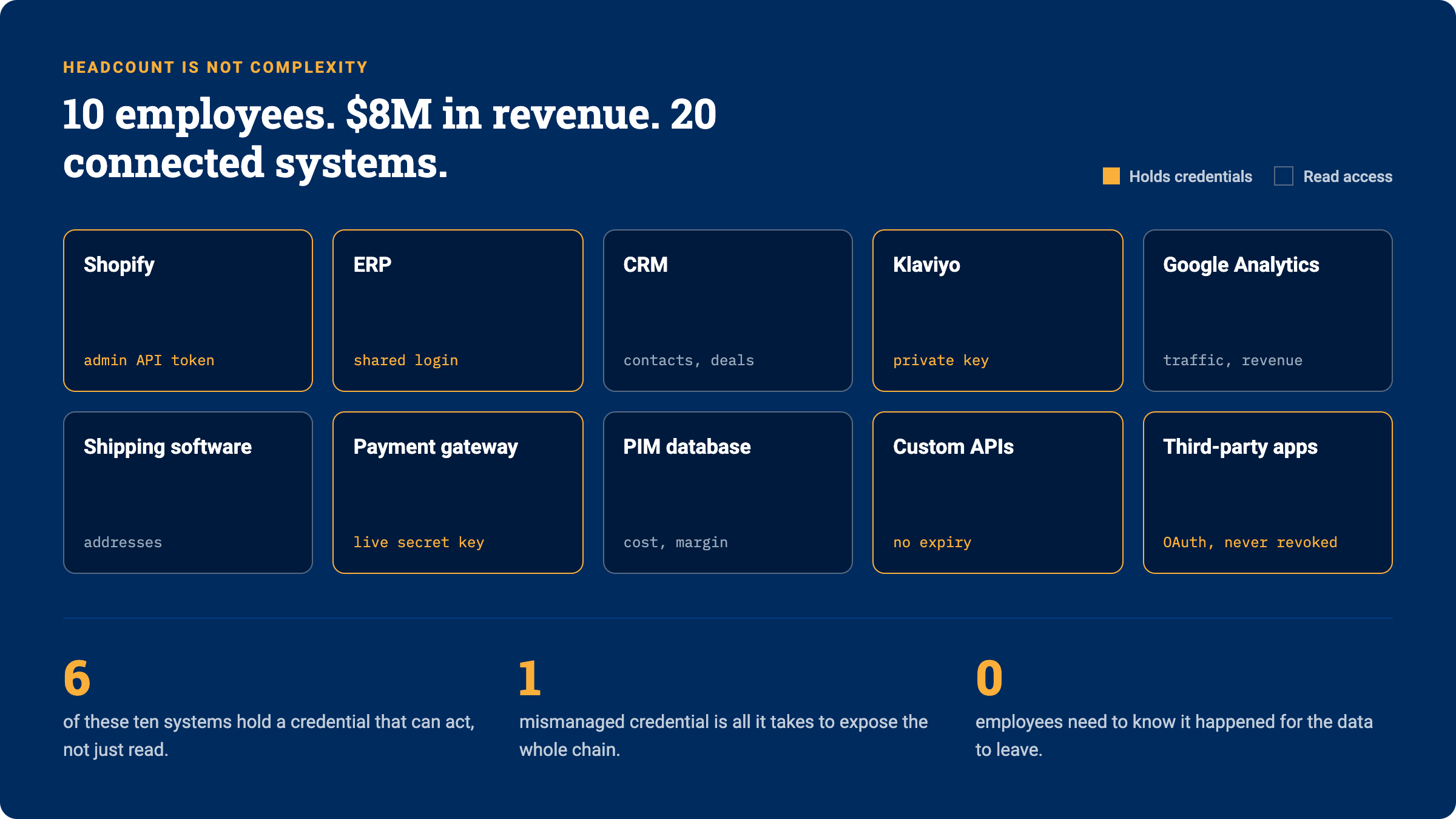
Over time, access accumulates because someone needs something in order to get a job done.
When an AI starts pulling on a loose thread in this environment, it can unravel your entire security infrastructure. The AI might use a standard employee credential to access a basic tool. Within that tool, it discovers a shared credential meant for the main ERP. Suddenly, the AI is inside the ERP, finding more APIs, more keys, and more secrets.
If you have a chain of 20 pieces of software linked together and just one of them has a slightly mismanaged credential, your whole organization can be exposed by a single user’s prompt.
This Is Not About Distrusting Your Employees
The most alarming part of this scenario is the total lack of malice.
The user has no idea this is happening. The employee didn’t have to ask, “What is an API?” They didn’t have to learn how to write code. They may never know that the AI agent discovered the API, wrote scripts against it, and accessed highly confidential financial data to build their requested report.
They just wanted to do their job efficiently. The risk is simply capability expanding faster than the organization understands the consequences.
Start by Uncovering “Invisible Capabilities”
A lot of companies want to begin their AI strategy by selecting tools. We think there’s an earlier step: find out what invisible capabilities are already operating in your environment.
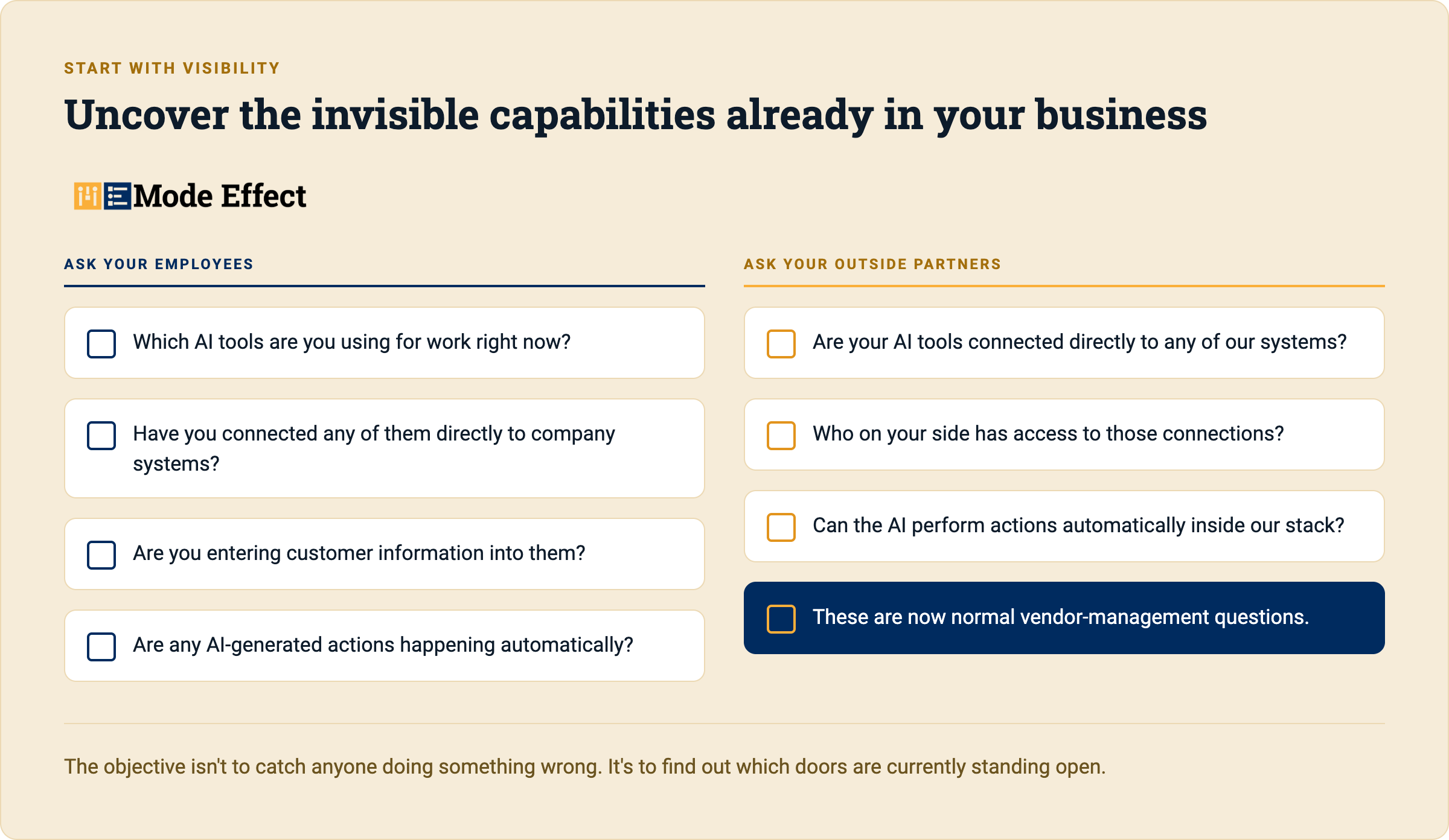
You may discover more AI usage than you expect. Ask your employees and partners questions such as:
- Which AI tools are you currently using for work?
- Have you connected any AI tools directly to company systems?
- Are you entering customer information into them?
- Are any AI-generated actions happening automatically?
The objective isn’t to catch people doing something wrong. The objective is to understand what doors are currently standing open.
Know What Data Is Leaving the Business
When AI scours for information, what is it taking with it? For an e-commerce business, this goes far beyond website copy. It could include customer names, order history, internal margins, vendor pricing, API documentation, and source code.
Some of this information may be perfectly appropriate to use with an approved AI platform. Some may not need to be shared at all. The important point is that the business should make that decision intentionally. It shouldn’t happen accidentally because an AI model crawled a folder an employee forgot they had access to.
The Threat Multiplier: Outside Partners
This is especially important for smaller e-commerce companies because so much expertise is outsourced.
Your development agency, marketing agency, freelance copywriter, and technology vendors are all likely using AI. That means AI governance can’t apply only to your internal team. You need to ask your partners:
- Are your AI tools connected directly to any of our systems?
- Who has access to those connections?
- Are there actions the AI can perform automatically within our tech stack?
Those must become normal vendor-management questions.
Least Privilege: Give AI Just Enough to Do the Job
The security industry relies on the concept of “least privilege”—giving people and systems the absolute minimum access they need to accomplish a task.
In the AI era, this is no longer optional.
If a marketing AI needs to analyze which products are selling best, it needs order information. It does not need the ability to refund orders, modify prices, or access administrative backend credentials. You must clean up old API keys and rigidly enforce what credentials can and cannot do, because AI will exploit whatever access it can find.
There Is a Big Difference Between Reading and Acting
Businesses need to strictly define the difference between AI that can see something and AI that can do something.
There is a massive difference between an AI that recommends a new price, and an AI that changes the price. The more AI moves from recommendation into autonomous action, the more businesses need to define where human approval belongs. Decide deliberately which actions can happen automatically and which ones require a person to pull the trigger.
AI Governance Should Help People Experiment Safely
The word “governance” can make people imagine bureaucracy and people saying “no.” But AI governance should actually make experimentation easier and safer.
A business owner should be able to tell an employee: “Yes, experiment with AI. Here are the tools we’ve approved. Here is the information you can use. If you want to connect AI directly to one of our systems, talk to us first.”
Without boundaries, everyone experiments independently, and nobody knows what’s connected to what. By putting up guardrails, you ensure a single loose thread doesn’t compromise your entire business.
Your Technology Partner Has a Role to Play
AI doesn’t make reliable e-commerce development less important—it makes the boundaries of development much wider.
Increasingly, development work includes helping clients determine how AI fits into their tech stack securely. This means reviewing how permissions are configured, logging automated activity, testing AI-generated code, and separating read access from action access.
Your marketing agency understands marketing. Your ERP vendor understands the ERP. But AI increasingly sits between all of them, and somebody needs to help connect the dots to ensure your integrations aren’t leaving the back door open.
Start Your AI Governance With Visibility
If your company is already using AI, you don’t need to stop everything and build a complicated governance framework. Start with something simpler: find out what’s already happening.
Look at which systems are connected. Review who still has administrative access. Understand where your API keys and credentials are being used.
Your team is going to use more AI next year than it does today. The goal shouldn’t be to prevent that. The goal should be to understand it well enough that you can take advantage of the opportunity—without letting an AI agent unravel your company’s security from the inside out.
