

The Marketing Meeting No CMO Wants to Have
There’s a particular kind of meeting that every marketing leader eventually finds themselves in.
Sales are down.
Paid media looks worse than it did a few months ago.
Someone has Google Ads open. Someone else is looking at GA4. The ecommerce platform is showing another number entirely.
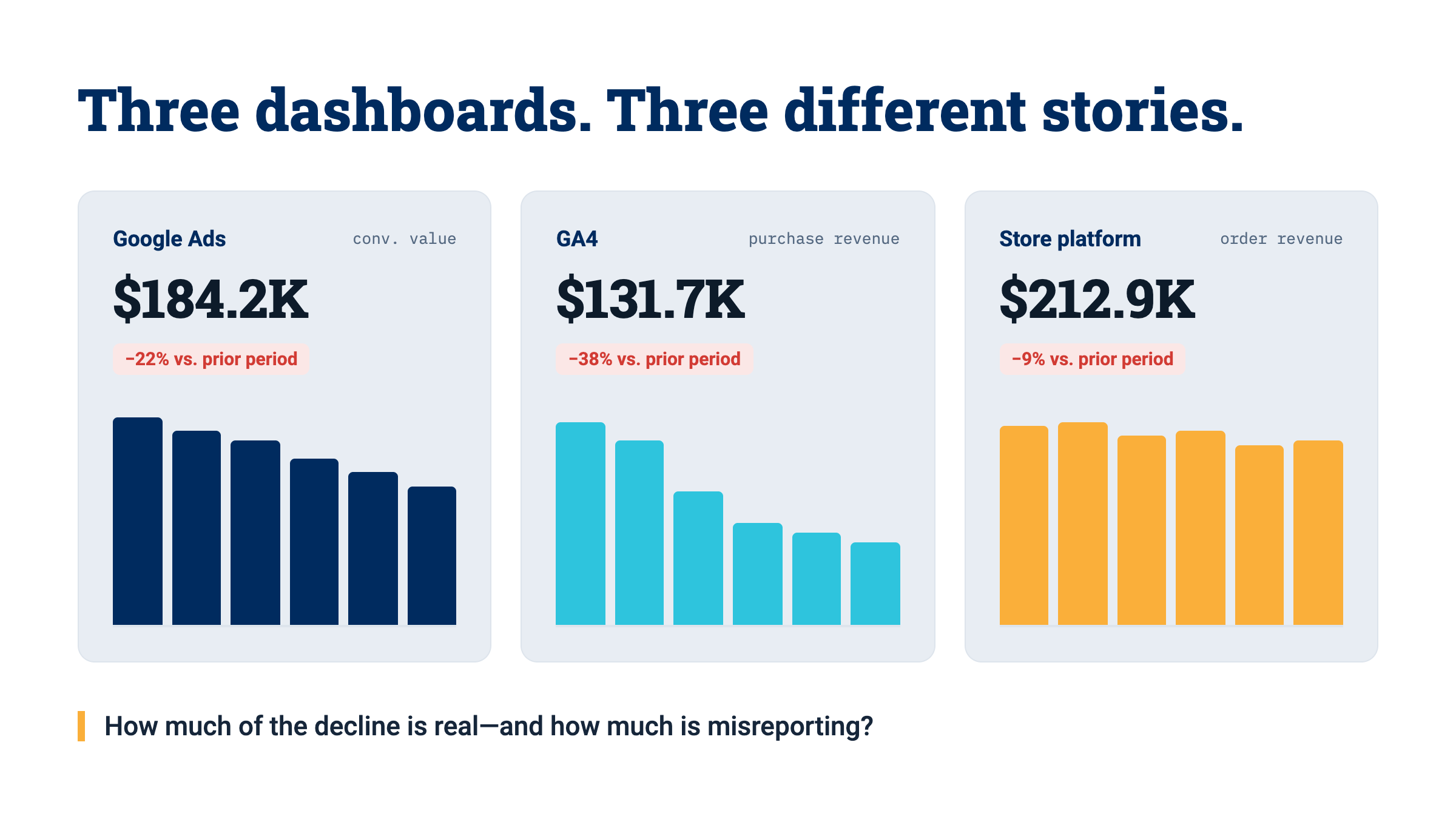
And eventually the conversation turns toward the person responsible for marketing.
What happened?
That was essentially the situation in a client meeting we had recently.
The company had noticed what looked like a significant decline in both Google and Microsoft advertising performance. At the same time, they were dealing with other website issues, so there was a growing sense that something wasn’t right.
Was traffic getting worse?
Had the campaigns stopped working?
Was the website converting poorly?
Was there an attribution problem?
Or was something else happening entirely?
One person on the call put the problem pretty simply: they could see the decline, but they didn’t know how much of what they were seeing was real and how much might be misreporting.
That distinction is incredibly important.
Because before you start fixing marketing, you need to know whether the marketing is actually broken.
The pressure usually lands on marketing
If you’re the CMO, VP of Marketing, marketing director, or the person effectively sitting in that seat, you’re often the first person expected to explain what’s happening.
Revenue is down? Marketing question.
Customer acquisition costs are increasing? Marketing question.
Paid media return is declining? Marketing question.
Conversion rate falls? Usually still a marketing question.
But ecommerce performance doesn’t live neatly inside a marketing department.
A campaign can do its job perfectly, deliver the right visitor to the right page, and still fail because the site is slow, the checkout is confusing, a tracking event isn’t firing, a plugin breaks something, or the purchase never gets attributed back to the source that created it.
That is what makes the marketing seat uniquely difficult.
You can be held accountable for outcomes that depend on systems you don’t directly control.
And if the underlying data is wrong, you may be asked to explain something that didn’t actually happen the way the dashboard says it did.
In this case, the deeper we looked, the less comfortable we became with the data
The company’s Google Analytics and Google Tag Manager setup had been around longer than the people currently managing the marketing program.
That alone is not unusual.
We see this constantly.
Someone set up analytics years ago. Another agency adds conversion tracking. A developer modifies the checkout. A new marketing team arrives. Advertising platforms change. GA4 replaces Universal Analytics. Tags get added, removed, renamed, duplicated, or forgotten.
Eventually everybody is using the system, but nobody completely owns it.
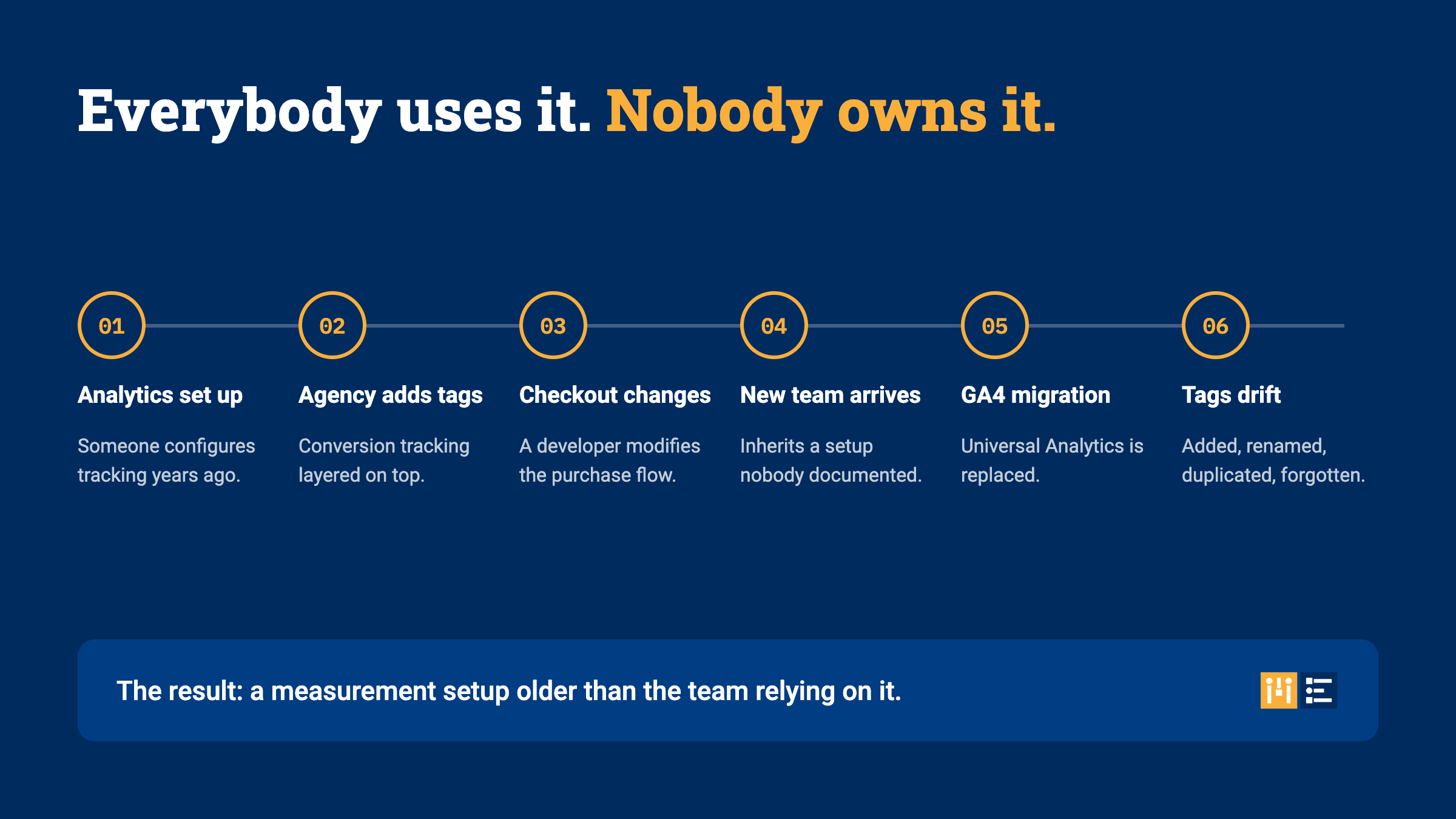
That’s close to what we found here.
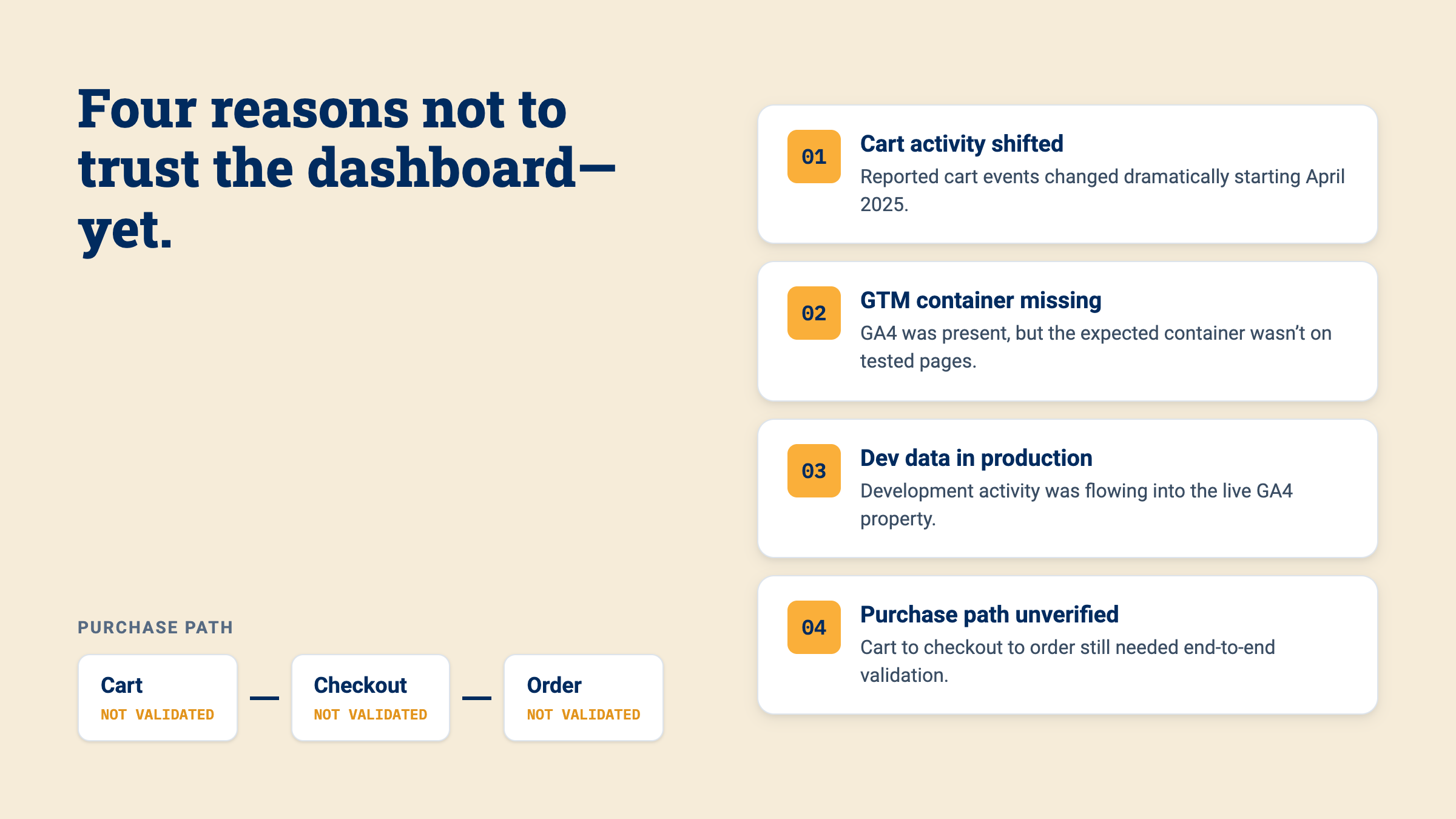
During our review, reported cart activity appeared to change dramatically beginning around April 2025.
On pages we tested, the expected Google Tag Manager container wasn’t appearing even though GA4 itself was present.
We also discovered that development activity had been making its way into the production GA4 property.
And the purchase path still needed to be validated end to end to confirm that transactions were being measured consistently from cart through checkout and completed order.
None of those problems, by themselves, tell you that an advertising campaign is performing well or poorly.
What they tell you is something more fundamental:
You don’t yet have enough confidence in the instrumentation to make an expensive decision based on it.
That’s where bad decisions start
Imagine you’re sitting in the marketing seat and a report tells you paid revenue is down 30%.
You need to react.
Maybe you reduce spend.
Maybe you shift budget from one campaign to another.
Maybe you replace creative.
Maybe you question the agency.
Maybe you decide Meta is producing lower-quality traffic and move more money into Google.
Any of those decisions could be completely reasonable.
But now imagine that the real issue was that purchase events had stopped being recorded correctly.
The campaigns might still be generating revenue.
Your dashboard just stopped giving them credit for it.
You can see how quickly that becomes dangerous.
You aren’t optimizing the marketing anymore.
You’re optimizing against a measurement error.
The reverse can happen too.
A channel can appear to be producing great results because attribution is overly generous or another part of the funnel is underreported.
Getting the Clarity You Need with Mode Effect
Navigating these data and attribution challenges requires deep platform expertise and holistic digital strategy. At Mode Effect, we specialize in foundational audits, Search Engine Marketing (SEM), conversion rate optimization, and analytics validation to ensure your marketing decisions are driven by accurate data—not measurement errors.
Before making costly adjustments to your ad campaigns, let us help you audit your setup, validate your tracking, and build a dependable foundation for growth.
