
Why Mature Subscription Brands Are Reconsidering Shopify
A practical framework for evaluating Shopify, Shopify Plus, and WooCommerce through the lenses of operational fit, total cost of ownership, and responsibility.
For years, Shopify has deservedly earned its reputation as one of the easiest ecommerce platforms on which to launch and scale. If you are starting an online business, there is a good chance we would recommend it.
The platform removes much of the burden associated with hosting, infrastructure, updates, security, and checkout management. It lets entrepreneurs begin selling quickly and focus on products and customers. For many companies, that managed model remains valuable long after launch.
Yet mature subscription brands often reach a point at which the questions change. They are no longer asking only how to improve conversion or add the next feature. They are evaluating how much control they need over recurring billing, payment recovery, customer accounts, fulfillment logic, reporting, and integrations—and how much responsibility they are prepared to accept in return.
Over the past several years, Mode Effect has spoken with companies at exactly this stage. Shopify had not necessarily failed them. Their operating models had become more specialized.
Many were subscription businesses. Recurring-revenue commerce combines retail complexity with the ongoing management of customer relationships. The technology stack may coordinate renewals, failed payments, shipping schedules, memberships, retention programs, warehouses, and financial reporting. As the business grows, separate SaaS products often accumulate around each requirement.
Eventually, leadership asks a broader question: Does our current platform still offer the right balance of convenience, cost, control, and responsibility?
That is the question this guide is designed to answer.
The issue is operational fit, not a platform contest
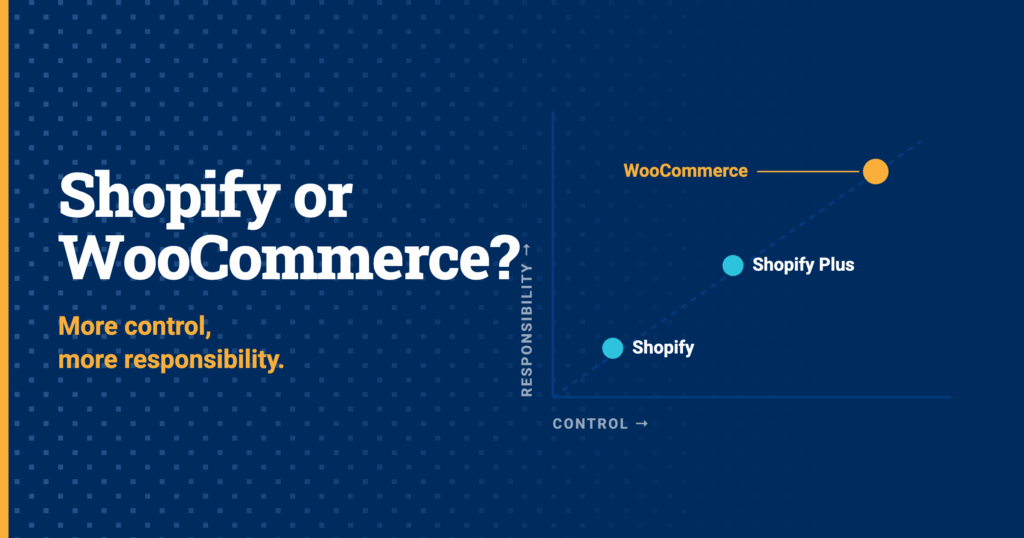
Shopify is a managed commerce platform with a controlled extension framework. WooCommerce is an open-source foundation with wider access to the application, database, and hosting environment.
Neither model is universally better.
Shopify can reduce infrastructure risk and accelerate delivery. WooCommerce can provide deeper control over business logic, data, integrations, and deployments while transferring more accountability to the merchant.
The useful question is, “Which allocation of control and responsibility best supports the next three to five years of this business?”
Four patterns we see in mature subscription businesses
The brands that begin evaluating their platform tend to raise four related concerns.
1. The technology portfolio is becoming expensive
The complaint is rarely the Shopify subscription alone. Cost accumulates across the platform plan, subscription software, search, loyalty, reviews, reporting, middleware, custom apps, integration monitoring, and agency or developer support.
The problem appears when leaders cannot connect the combined spend to business outcomes or when tools duplicate data and functionality. The relevant figure becomes the fully loaded cost of commerce.
2. Workarounds are becoming part of daily operations
Manual inventory corrections, order exports, fulfillment exceptions, duplicate customer records, and delayed reporting create staff hours, errors, slow decisions, and service contacts. A custom integration may be economically sensible if it eliminates a process performed hundreds of times each month.
3. Specialized workflows require more control
Mature businesses may require customer-specific pricing, unusual renewal cycles, substitutions, dealer approval, regulated fulfillment, multiple warehouses, or a proprietary retention model.
Shopify supports substantial customization through apps, APIs, and extension points. The decision is whether important rules can operate reliably inside that model and whether wider application-level control would create enough value.
4. Subscription complexity compounds
A subscription is an evolving agreement. Customers may pause, skip, swap, upgrade, reschedule, or receive a different assortment at each renewal. Payment recovery, inventory, tax, and fulfillment must remain synchronized.
An app-based subscription stack can manage this well. Complexity emerges when subscription data and logic must also drive an ERP, warehouse management system, customer service platform, loyalty program, and finance model. The number and quality of those handoffs matter as much as the storefront itself.
The subscription business maturity curve
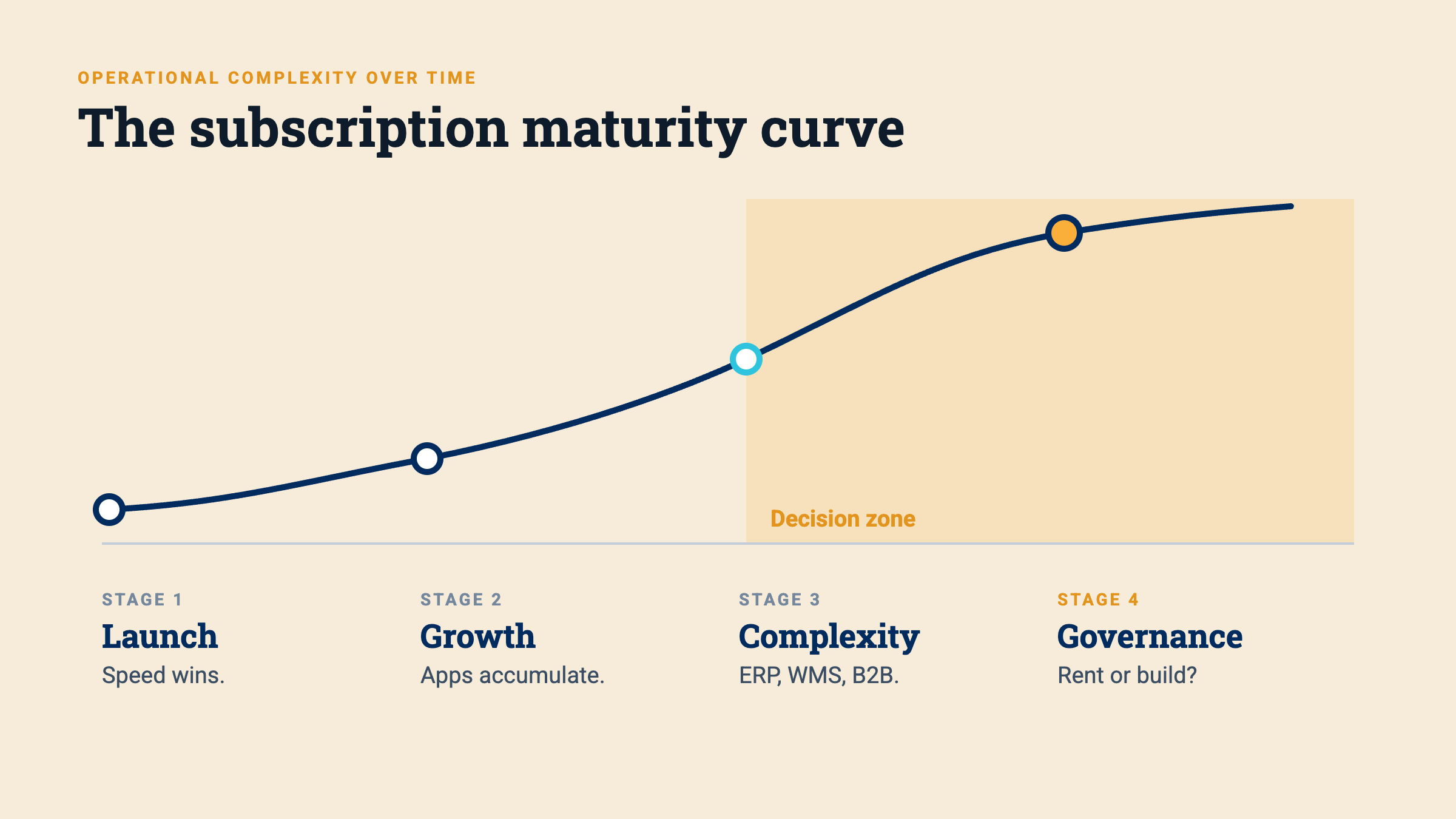
Recurring-revenue companies often move through four stages.
Stage 1: Launch. Speed and validation matter most. Shopify’s managed model removes decisions that could delay launch.
Stage 2: Growth. Marketing expands and the company adds applications. The ecosystem remains an advantage, although recurring costs begin to rise.
Stage 3: Operational complexity. The business introduces an ERP, warehouse automation, B2B selling, international operations, or sophisticated subscription rules. The store becomes one component in a larger system.
Stage 4: Platform governance. Leadership decides which capabilities to rent or build, who owns the logic, and how the stack will be governed. Some companies choose Shopify Plus and custom apps; others adopt a more open platform. Maturity makes the decision more consequential without prescribing the answer.
Convenience and ownership are a tradeoff
Shopify’s managed infrastructure, security program, checkout, upgrades, and ecosystem have real economic value. A business that moves away must replace those benefits through internal staff, an agency, managed hosting, or a combination of partners.
Convenience can also create dependencies. Critical logic may live across vendors. Exportable data may still be difficult to reconstruct elsewhere. Integrations may depend on API behavior, app pricing, or product roadmaps.
WooCommerce changes the degree and location of dependency. A merchant can access and modify more of the code, database, and hosting stack, and can usually change providers without changing the underlying commerce application. It will still depend on WordPress, WooCommerce, extensions, payment gateways, hosts, developers, and open-source maintainers.
Greater ownership therefore means greater choice over dependencies—not freedom from them.
Before migrating, test Shopify’s higher-control options
A migration should follow a serious attempt to solve the problem within the current platform.
Shopify Plus
Shopify Plus can be the better answer when a brand needs organizational controls, expansion stores, B2B capabilities, or deeper checkout customization while retaining managed infrastructure.
Plus merchants can use checkout UI extensions on the information, shipping, and payment steps. Shopify also provides B2B company accounts, catalogs, payment terms, quantity rules, and volume pricing. These features may address requirements that once seemed to demand another platform.
Compare the incremental Plus investment with migration cost and risk. If Plus resolves the high-value constraints, moving may destroy more value than it creates.
Custom apps and Shopify Functions
A custom app can encode proprietary workflows, connect internal systems, and replace several narrow SaaS tools.
Shopify Functions allow developers to extend selected backend logic, including discounts, delivery options, payment methods, validation, and fulfillment behavior. Public apps containing Functions can run on most plans, while custom apps using Functions require Shopify Plus, and availability varies by Function API.
This approach adds control without making the merchant responsible for the core runtime, provided the required logic fits Shopify’s schemas, limits, and supported extension points.
Shopify Flow and integration redesign
Shopify Flow can automate workflows across Shopify and compatible apps using triggers, conditions, and actions. Depending on the plan, it can also send HTTP requests or use tasks created by custom partner apps.
Consolidating middleware, clarifying systems of record, replacing batch exports with event-driven workflows, or adding monitoring can remove substantial friction without replatforming.
Shopify APIs and subscription architecture
Shopify’s Admin, Storefront, customer account, and purchase-option APIs support many custom commerce experiences. Its purchase-option model includes selling plans and subscription contracts for recurring products.
An API-first integration or headless storefront may solve presentation and orchestration needs while preserving Shopify as the transaction engine. Headless architecture adds development, testing, observability, and content-management obligations, so it still needs a clear business case.
If Plus, a custom app, Flow, or an integration redesign resolves the core constraints at an acceptable three-year cost, staying on Shopify is usually the lower-risk choice.
The Commerce Ownership Index
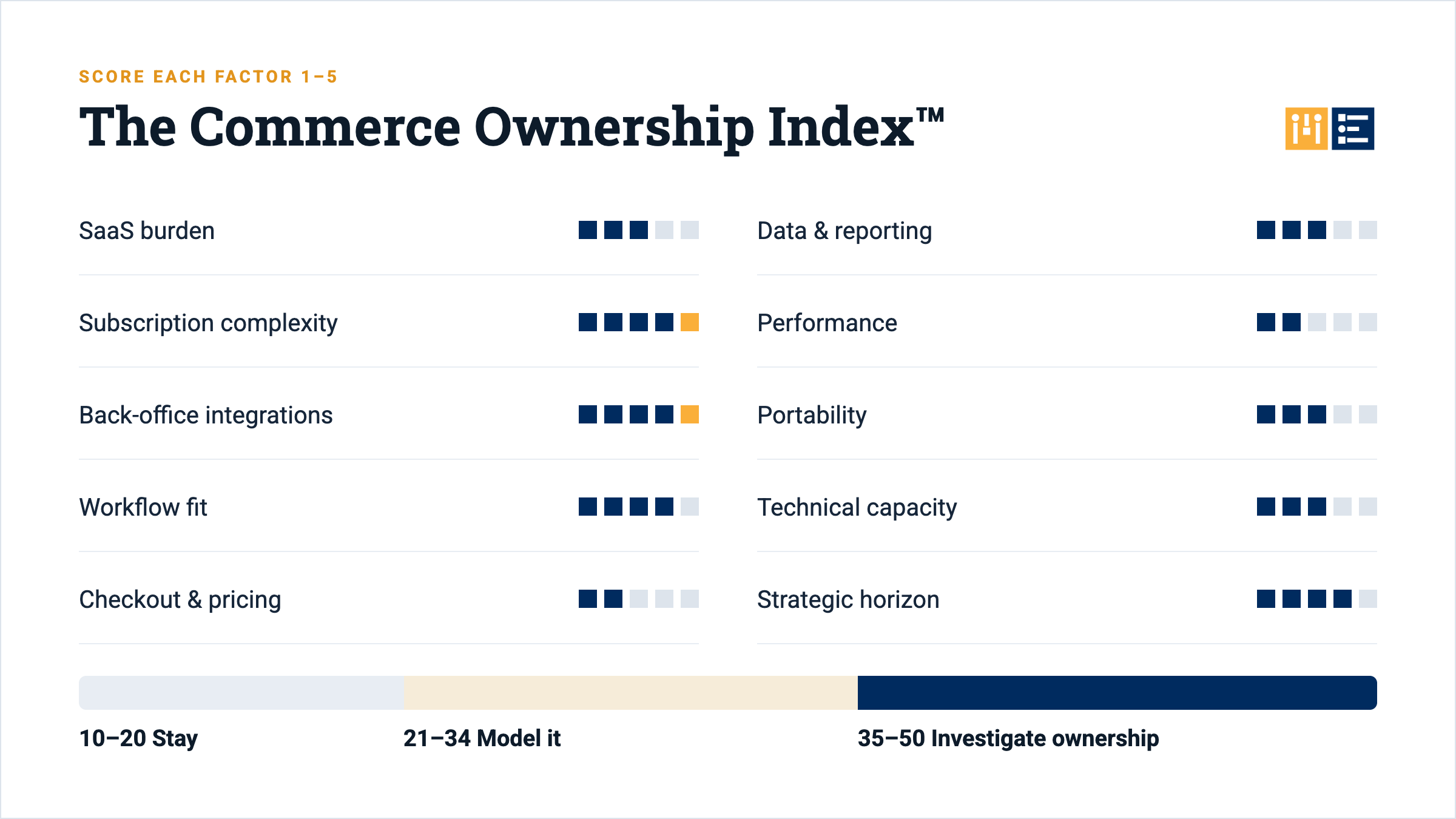
The Commerce Ownership Index screens how seriously a company should evaluate greater ownership. Score each factor from 1 to 5. It should precede technical discovery, not replace it.
| Factor | 1 point | 3 points | 5 points |
|---|---|---|---|
| Platform and SaaS burden | Low and stable relative to gross margin | Material and rising | One of the largest controllable technology costs |
| Subscription complexity | Standard cadence and simple self-service | Multiple plans, bundles, or recovery rules | Proprietary renewal, fulfillment, pricing, or retention logic |
| Back-office integrations | Few, loosely coupled connections | ERP, WMS, or finance integrations | Several mission-critical, bidirectional, near-real-time integrations |
| Workflow fit | Processes follow platform conventions | Regular exceptions and middleware | Core teams rely on manual workarounds or duplicate entry |
| Checkout and pricing | Standard DTC checkout | Meaningful promotions, markets, or B2B rules | Specialized pricing, approval, payment, or regulatory requirements |
| Data and reporting | Native reports are sufficient | BI requires regular data assembly | Commerce data models are strategic intellectual property |
| Performance and infrastructure | Standard traffic pattern | Large catalog, renewals, or periodic peaks | Workload needs architectural tuning, isolation, or custom observability |
| Portability and governance | Switching cost is not a concern | Vendor concentration is reviewed | Portability is a board, investor, compliance, or continuity priority |
| Technical capacity | No retained technical owner | Reliable agency or small internal team | Experienced internal leadership and accountable delivery partners |
| Strategic horizon | Business model is still changing quickly | Requirements are becoming clearer | Stable model and willingness to invest over three to five years |
Use 2 or 4 points when the business falls between the descriptions.
10–20: Stay and optimize. The managed model is probably producing more value than greater control would. Rationalize apps, improve integrations, and strengthen governance within Shopify.
21–34: Model the options. Compare Shopify optimization, Shopify Plus, custom app development, and an owned-platform scenario. Build a three-year total-cost model before selecting a direction.
35–50: Investigate ownership. The company may benefit from a more open platform, provided it has the technical capacity and risk controls to operate one. A high score is a reason for discovery, not an automatic migration recommendation.
Have finance, operations, marketing, and technology score it together. Differences between their answers often reveal the real problem.
Model total cost of ownership, not license price
A useful comparison includes every material cost required to run and change the commerce system over at least three years.
For Shopify, include the plan, payment-related costs relevant to the company’s configuration, applications, middleware, custom development, integration support, data tooling, and internal labor. Do not assume every cost rises directly with revenue; plan tiers and app pricing use different fixed, usage-based, and negotiated structures.
For WooCommerce, include discovery, design, development, migration, hosting, security, extensions, observability, maintenance, testing, incident response, enhancements, and internal governance.
Then model manual hours, exception rates, support contacts, failed renewals, deployment time, and the exposure of downtime or data errors.
WooCommerce often has a higher first-year cost. It may produce a lower or more controllable recurring cost when it replaces expensive applications and manual work. It may also cost more than Shopify over the full period if customization proliferates or the platform is poorly governed. The result depends on the operating model and build scope.
An illustrative three-year example
Editorial note: The following is an illustrative composite based on patterns seen in platform evaluations. It is not a claim about a single Mode Effect client. Replace it with verified client metrics before publication if the editor requires a real-world case study.
Consider a subscription brand with $18 million in annual online revenue and 28,000 active subscribers. Its platform, app, middleware, and integration-support costs total $31,400 per month. Operations and customer service spend approximately 220 hours each month reconciling inventory, correcting subscription exceptions, and preparing reports. At a fully loaded labor cost of $42 per hour, that is another $110,880 per year.
The current operating cost is therefore about $487,680 per year before major enhancement projects.
The company first models a Shopify Plus and custom-app option. Consolidating three apps and replacing a batch ERP connection would reduce manual work, but an important mixed-cadence fulfillment requirement does not fit the proposed architecture cleanly. Leadership then compares a WooCommerce build.
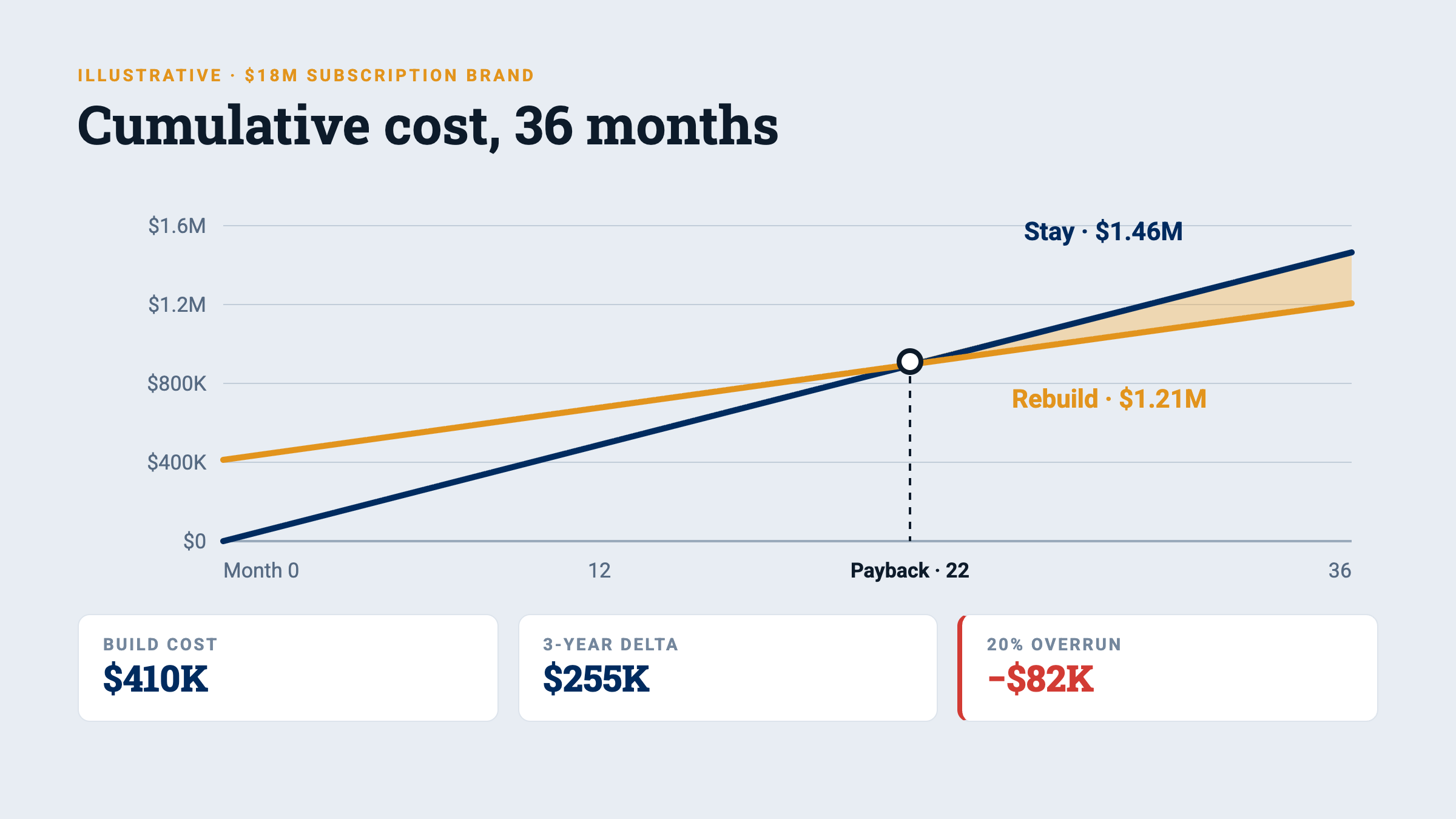
The modeled WooCommerce program requires a $410,000 implementation investment. Hosting, security, maintenance, extensions, and retained development total $18,600 per month after launch. Automation reduces the relevant manual work from 220 to 85 hours per month.
On those assumptions:
- Existing three-year operating cost: $1,463,040
- WooCommerce implementation plus three years of operations and remaining labor: $1,208,120
- Modeled three-year difference: $254,920
- Approximate payback period: 22 months
That result does not prove WooCommerce is cheaper. A 20 percent implementation overrun would consume $82,000 of the benefit. Additional staffing, delays, or lower labor savings could eliminate it; better self-service or fewer errors could improve it.
Use the company’s contracts, invoices, labor observations, incident history, and roadmap. A defensible model exposes assumptions and sensitivity ranges.
Infrastructure and performance: capability requires engineering
WooCommerce gives a team access to hosting, caching, database behavior, deployments, and observability—potentially valuable for large catalogs, renewal workloads, or specialized integrations.
High-Performance Order Storage uses dedicated WooCommerce tables and indexes for order data, reducing reliance on the traditional WordPress posts and post-meta tables. HPOS is enabled by default for new installations, although extension compatibility still needs to be verified.
A well-designed implementation may use object caching, a CDN, tuned database queries, asynchronous processing, and application monitoring. Architecture should follow measured workload; unnecessary components only create complexity.
Shopify operates the underlying platform. That limits low-level tuning while reducing the failure modes a merchant must manage. Compare the value of architectural control with its cost.
Operational efficiency is a systems problem
A direct ERP integration can synchronize inventory, pricing, orders, and refunds. Warehouse automation can exchange orders, tracking, and exceptions. A customer portal can support pauses, skips, swaps, rescheduling, and payment updates. A governed data model can improve reporting and personalization.
All of these outcomes are possible on Shopify or WooCommerce. The difference is how each platform permits them to be implemented, what constraints apply, who maintains them, and how portable the result is.
Before replatforming, map five to ten high-cost workflows. Record the systems, manual touches, exception volume, error cost, and owner. This prevents inefficient processes from being recreated.
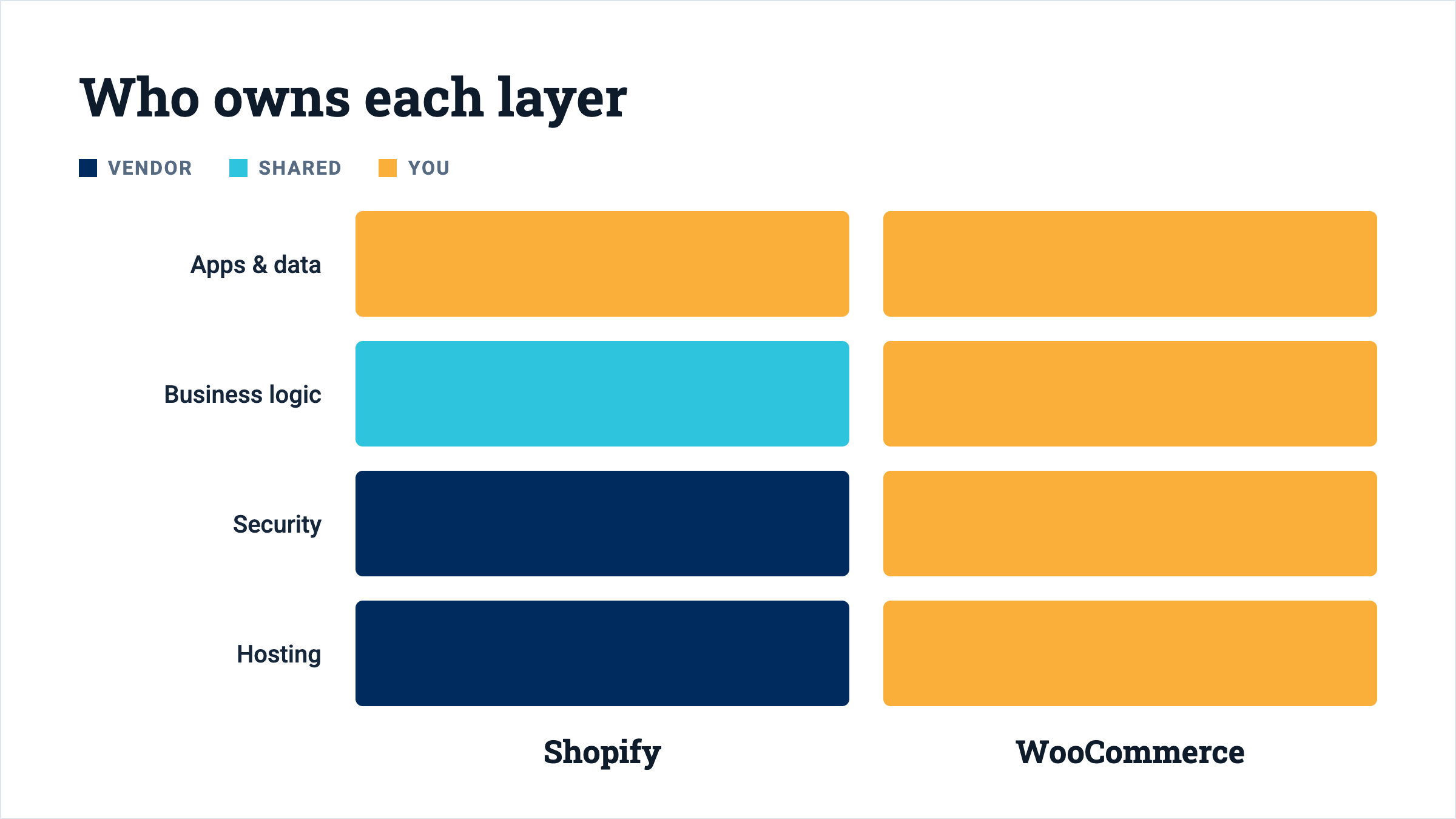
The responsibilities of ownership
Greater control expands the merchant’s risk surface. A WooCommerce owner or its retained partners must govern:
- Hosting capacity, uptime, backups, and disaster recovery
- Core, plugin, and theme updates
- Vulnerability monitoring, access control, and incident response
- Payment and privacy compliance responsibilities applicable to the business
- Extension quality, compatibility, licensing, and vendor continuity
- Automated tests, staging, deployment, and rollback procedures
- Performance monitoring and capacity planning
- Documentation, source control, and knowledge transfer
These obligations require a named owner, budget, service levels, and operating procedures. “We own the code” has limited value if only one contractor understands it or releases cannot be tested safely.
Shopify transfers more core responsibility to the vendor, while the merchant still owns app selection, permissions, custom code, integrations, data governance, and continuity. Ownership changes who is accountable for each layer.
When WooCommerce is a strong candidate
WooCommerce deserves evaluation when several of these conditions are present:
- Proprietary subscription, pricing, fulfillment, or customer-account logic is central to the business model.
- Mission-critical integrations require data access, timing, or orchestration that is difficult to achieve reliably through the current platform.
- App and middleware consolidation has a credible, measured economic benefit.
- The organization treats commerce data structures and workflows as strategic assets.
- The company has stable requirements and a three-to-five-year investment horizon.
- An accountable internal leader and qualified technical team or partner can operate the platform.
- The benefit remains attractive after contingency, maintenance, security, and internal labor are included.
A migration justified only by app frustration or license cost is unlikely to have a durable business case.
When Shopify or Shopify Plus is the better choice
Staying on Shopify is often the right decision when:
- The catalog, checkout, subscription, and fulfillment model largely fit established platform patterns.
- Managed infrastructure and rapid feature delivery are more valuable than low-level control.
- The internal team is lean and does not want to own release engineering, security operations, and hosting governance.
- Shopify Plus, Functions, Flow, APIs, or a custom app can solve the highest-value constraints.
- Current applications perform well and their cost is reasonable relative to the labor and risk they remove.
- International, omnichannel, or B2B needs align with Shopify’s native roadmap.
- The migration case depends on optimistic savings or unproven conversion improvements.
The strongest platform decision may be a better-governed Shopify architecture: fewer apps, clearer systems of record, improved observability, and a custom integration where the economics justify it.
Migration is an investment thesis
A replatform should make measurable claims: reduce a defined cost, support a capability that changes revenue or margin, lower an identified risk, or improve execution speed.
Those claims should be tested against at least three scenarios:
- Optimize the current Shopify implementation.
- Upgrade to Shopify Plus and add targeted custom development.
- Move to WooCommerce or another more open architecture.
Compare them over three years, including implementation risk, opportunity cost, ongoing ownership, and reversibility. Choose the operating model that best fits the company.
The real decision
Mature subscription brands are rarely searching for a different shopping cart. They are deciding where their business logic should live, how much control it requires, and which risks they are equipped to manage.
Shopify remains one of the strongest ecommerce platforms available. WooCommerce can be a sound long-term investment for businesses whose specialized operations justify deeper control. Neither conclusion should be assumed in advance.
The right platform is the one that supports the company’s strategy with an acceptable combination of cost, adaptability, dependency, and responsibility.
Not sure whether your platform still fits?
Mode Effect can assess your Commerce Ownership Index™, map your highest-cost workflows, and model the three-year economics of Shopify optimization, Shopify Plus, and WooCommerce. You will leave with a practical recommendation—even if the right answer is to stay where you are.
Schedule a commerce platform assessment →
